

This article was co-authored by Fielo and Sasi Bhushan Veeramachaneni.
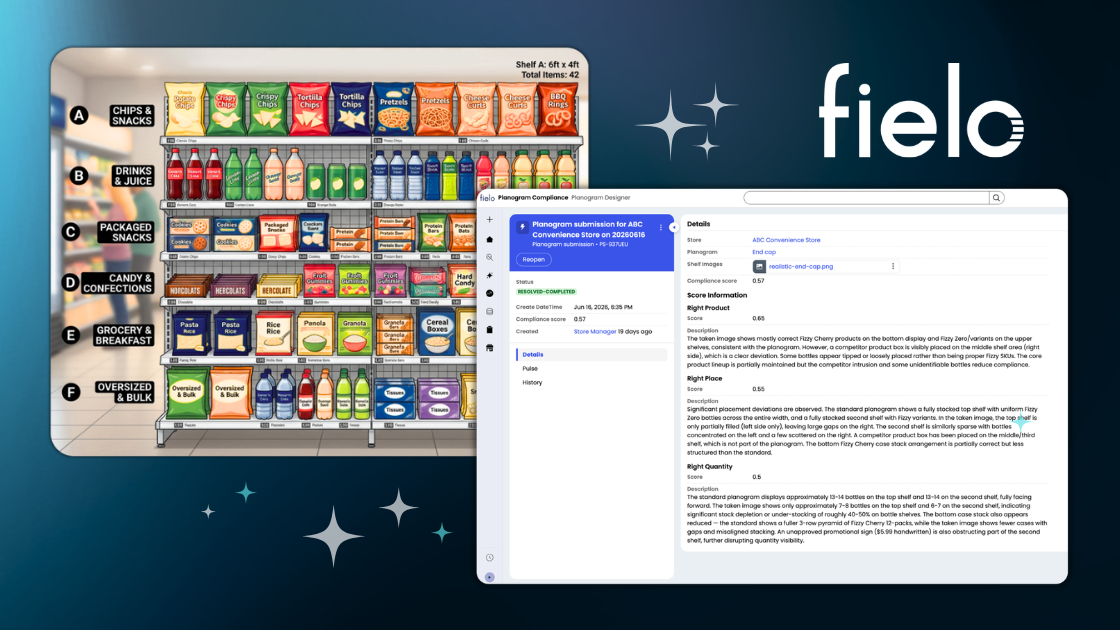
Walk into any store and look at the beverage cooler. That eye-level row of a flagship cola, the sports drinks up top, the value packs at the bottom, none of it is accidental. It is a planogram: a negotiated contract between the brand and the retailer that dictates exactly how products should be displayed. Shelf position is not decoration; it is distribution strategy. A misplaced facing is silent revenue leakage, every hour of every day, across thousands of outlets.

Above: a sample planogram for a convenience store
For decades, the industry enforced this contract in the most expensive way imaginable, by putting a human in a car and asking them to go look. Associates cover ten to fifteen stores a day, fighting traffic, negotiating access, and ticking checklists against a printed reference. Multiply that by hundreds of associates across dozens of markets, week after week, and you understand what brands quietly spend just to check whether their own products are in the right place. That was the rule of the game. Fielo and Launchpad just rewrote it.

About Fielo: Fielo is a leader in the incentive program software space that helps companies transform human behavior through rewards systems, powering programs for brands such as Google and Audi. Fielo partnered with Launchpad.io to replatform their core loyalty and incentive product and inject it with AI-powered capabilities. They also worked together to co-create the Planogram Compliance app featured in this article.
Rule #1 rewritten: "snap and know" replaces "go and look"
Fielo's Planogram Compliance application starts from a simple observation: if the whole exercise is a comparison (standard shelf vs. actual shelf), then it is exactly the kind of problem modern AI was built to solve. The brand defines the standard planogram image. A store rep uploads the current shelf photo. The application answers, in seconds, whether it is the right product, in the right place, in the right quantity. That single shift, from field verification to on-device submission collapses the cost curve.
Fielo case study: inside a real ABC Convenience Store submission
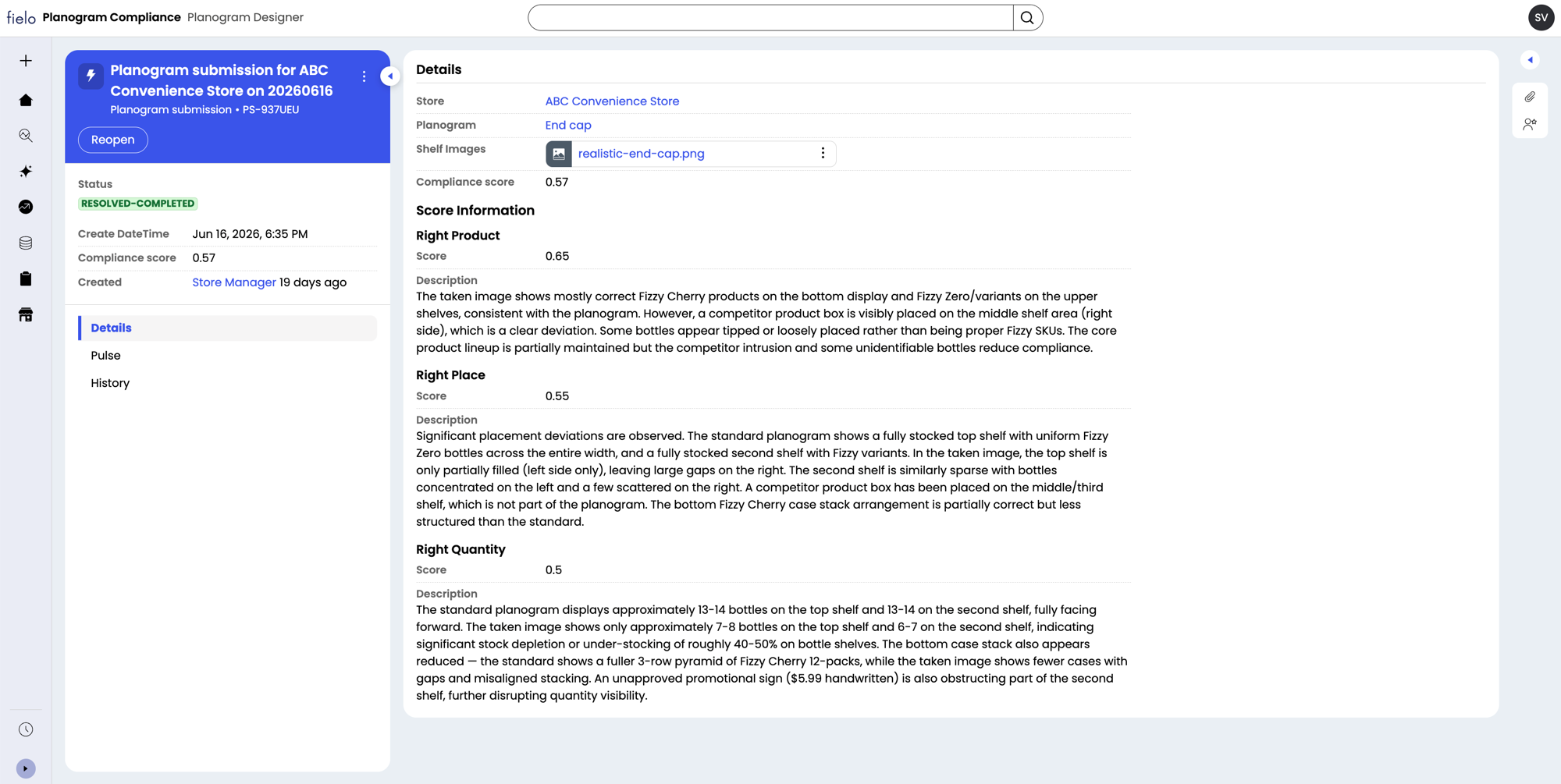
Here is what "compliance" actually looks like when Fielo's app runs on a real shelf. This is a live submission, against the End cap planogram uploaded by the store manager. The verdict comes back with overall score: Compliance score: 0.57. Fielo decomposed the problem into the three questions a brand actually cares about, and scored each independently:
|
Dimension |
Score |
What it answers |
|
Right Product |
0.65 |
Are the products on the shelf the ones the planogram specifies? |
|
Right Place |
0.55 |
Are they in the correct positions on the correct shelves? |
|
Right Quantity |
0.50 |
Are they stocked in the depth and facings the planogram requires? |
Each dimension carries a number and a narrative.
Three numbers replace a two-hour store visit. And crucially, the decomposition converts a headline into a decision: if Right Quantity consistently drags across a region, the problem is supply chain, not merchandising; if Right Place drags, it is store execution. Two different fixes, two different owners, visible at a glance.
Rule #2 rewritten: not everything needs to be "AI"
This is the app’s design philosophy: deterministic problems get deterministic solutions; judgement problems get AI; nothing gets more compute than it deserves.
A concrete example: when an associate uploads a shelf photo two weeks after the last one from the same store, is it a fresh capture or a re-uploaded old image gaming the numbers? That doesn't need a vision model, it needs a straightforward image-comparison function returning a deterministic verdict. That is what keeps the per-check cost low enough to actually validate every shelf, in every store, every week. The app operates on a deterministic workflow, while the AI is reserved for the one job only it can do: looking at the shelf and grading it.
Rule #3 rewritten: enterprise ideas ship in days, not quarters
The entire idea came together in a matter of days. Fielo started from a Blueprint: a natural-language description of the workflow that Launchpad's GenAI turned into a real, editable case type, data model, and UI in minutes, with the workflow explicitly orchestrating each AI step so the platform stays in control. The AI layer itself came out of the box with GenAI Connect rules for LLM and image-analysis calls, Agent rules for chat and processing agents, and platform-managed PII masking and usage metering, so Fielo spent its time on product decisions, not on plumbing.
The one place custom code was genuinely needed (the deterministic image-comparison guard) was handled through the launchpad-custom-function Agent Skill, one of the public skills Launchpad ships for coding agents like GitHub Copilot, Claude Code, and Cursor. (You can find out more about Launchpad Agent Skills in "From prompt to Python: building Launchpad custom functions with Agent Skills"). With Launchpad Agent Skills, the coding agents handled the boilerplate, which enabled the developer to focus on valuable product work – which only took a few minutes.
Zoom out and the shape of the build is clear: a small amount of custom logic riding on a large amount of platform. Fielo owned the domain judgement, the case type, the scoring rules, the associate experience. Launchpad owned everything else, the Blueprint-authored workflow, the GenAI and image analysis, the Function rule runtime, the Constellation UI, and the multi-tenant hosting and scaling underneath it all.
What the new rules mean for the brand
When a multi-day compliance loop compresses into seconds and per-check cost drops exponentially, the business model itself shifts. Coverage stops being rationed, enabling shelf checks for every store as frequently as needed. Correction happens in near real time; a non-compliant shelf found this morning can be fixed this afternoon. Field associates move up the value chain to store-manager relationships and on-shelf promotions.
The bigger idea
Planogram Compliance presents a model for a general pattern seen across industries. Across retail, distribution, and field operations, there are hundreds of workflows built around a human physically travelling to a location to confirm that reality matches a specification. Every one of them is a candidate for the same treatment. And that is the real headline:
Launchpad changed the game: The rule on speed used to be quarters; the new rule is days. The rule on cost used to be headcount and travel; the new rule is a photo and a few seconds of compute.
Fielo changed the game: The rule on coverage used to be sampling; the new rule is everywhere, always on. The shelf was always trying to tell brands whether they were winning or losing. Fielo built the listener. Launchpad made it possible to build it in days.
Build what's next on Launchpad
If Planogram Compliance can go from an idea to a running application in days, imagine what your team is sitting on. Every workflow in your business that depends on a human going somewhere to confirm that a reality matches a specification, a field audit, a site inspection, a delivery verification, or a merchandising check is a candidate for the same treatment.
Launchpad gives you the platform to get there:
- Blueprints turn a natural-language description into a real, editable workflow, data model, and UI in minutes.
- GenAI Connect, Agents, and image analysis ship out of the box, so the AI layer is a configuration decision, not an integration project.
- Agent Skills let your coding agent scaffold the custom Python, UI, or DX API extensions you need — from prompt to production-ready Function rule.
- Enterprise-grade hosting, identity, and scaling are handled by the platform, so you focus on the product, not the plumbing.
The rules of enterprise software have changed. The brands (and the builders) who adopt them first will come out on top (...of the shelf).
About the Author
Sasi Bhushan Veeramachaneni is a Senior Architect at Launchpad who is passionate about helping organizations build SaaS businesses by removing obstacles.