

Quick summary
In this article, we detail Lovable’s pricing plans for software development teams. We break down what each plan includes, the platform’s standout features, where the hidden costs creep in, and why Launchpad is the better long-term choice for teams building production-ready B2B software.
What does Lovable offer?
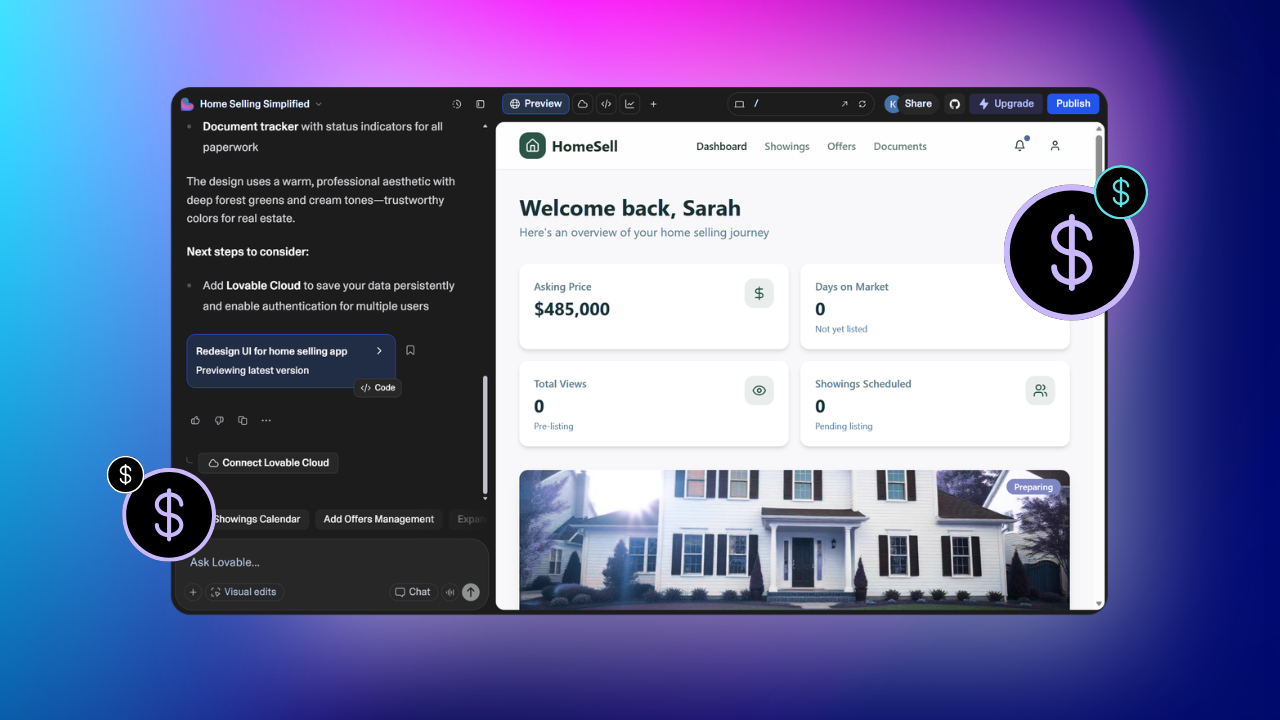
Lovable is an AI-powered platform that turns natural language prompts into functional web applications. It handles frontend, backend, database setup, and deployment in a single workflow.
On paper, it offers early-stage teams what they need to build an MVP quickly. In practice, the credit system that governs every interaction makes cost forecasting difficult, and user reviews describe debugging loops that burn through credits without resolving the original issue.
This Launchpad guide breaks down Lovable’s costs, identifies where hidden spending occurs, and compares it with a production-first alternative like Launchpad.
Why listen to us?
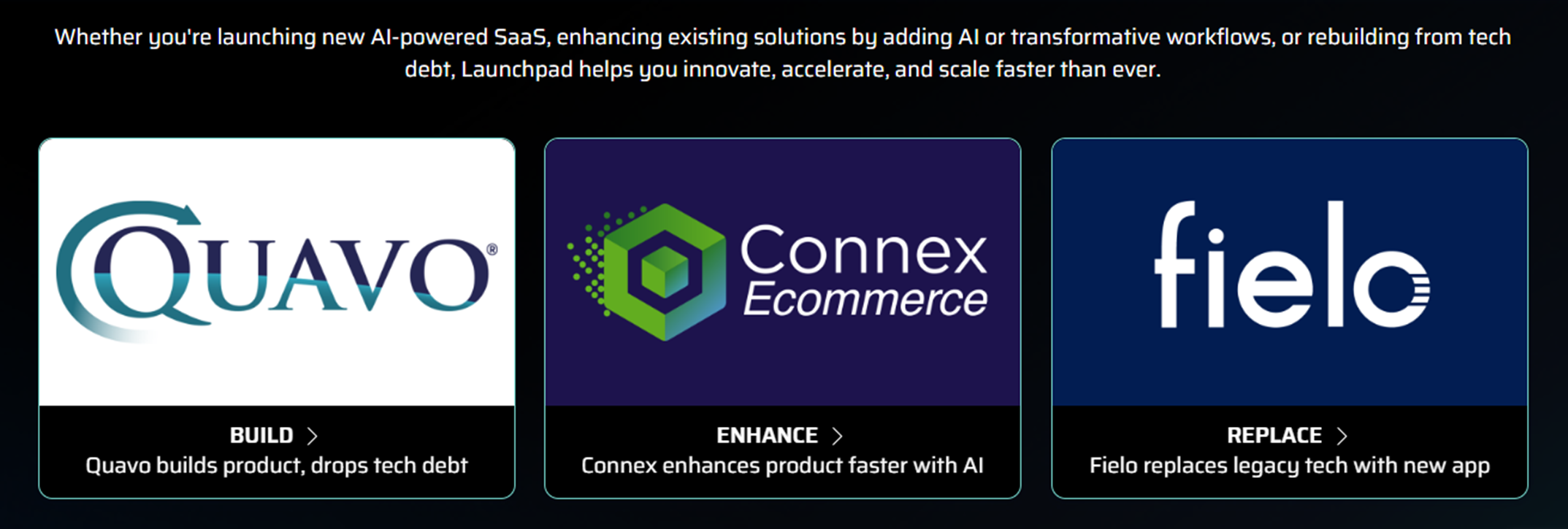
At Launchpad, we work with B2B software companies that build, enhance, and scale real products. Backed by Pega’s 40-year track record in enterprise workflow automation, Launchpad powers production-grade applications for companies like Fielo (which serves Google and Audi), Quavo, and Connex.
What is Lovable and who is it built for?
Lovable is an AI-powered app builder that turns natural language prompts into full-stack web applications. You describe what you want, say a dashboard, an admin panel, or a simple SaaS prototype, and Lovable generates the frontend and backend code using React, Tailwind CSS, and Supabase.
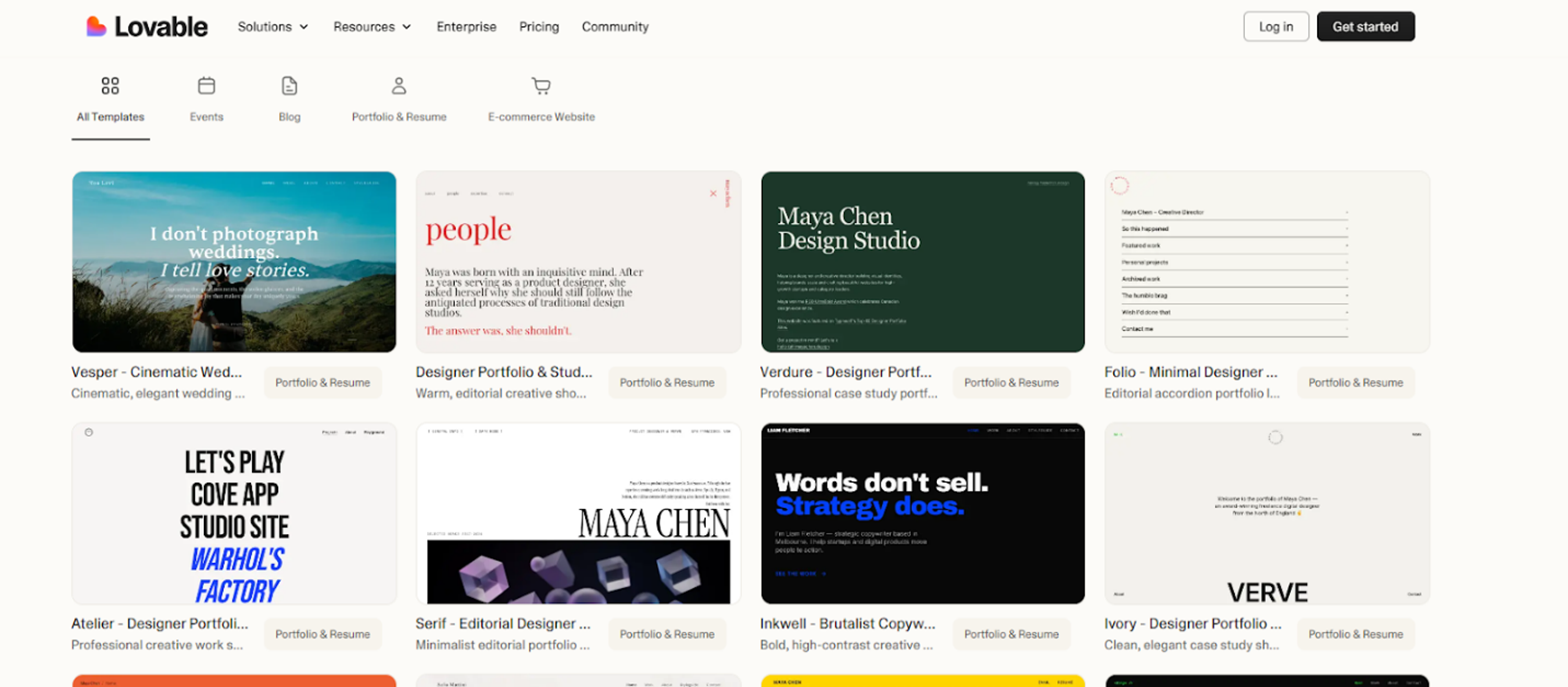
It’s built for non-technical founders who want to test an idea without hiring a dev team and for solo developers who’d rather skip the scaffolding and get straight to building.
Simply type in a few sentences, and minutes later, you’ll have a web application you can click through, demo, and iterate on.
Lovable pricing plans compared
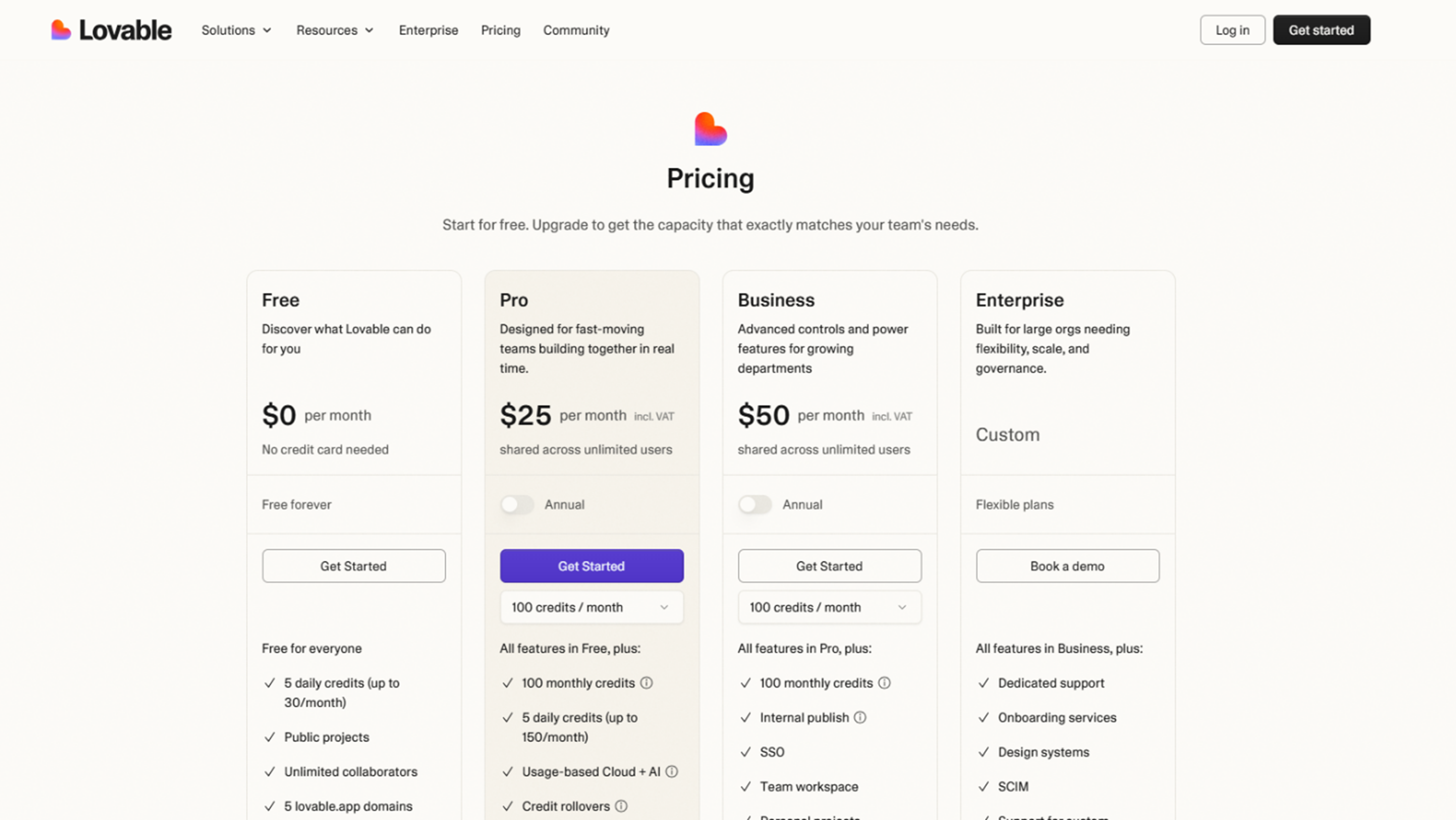
Here’s a quick look at Lovable’s current pricing structure.
|
# |
Plan |
Price |
Credits |
Key Features |
Best For |
|
1 |
Free |
$0 |
5 per day (30 per month) |
Public projects, GitHub sync, one-click deploy |
Testing the platform |
|
2 |
Pro |
$25 per month ($21 per month billed annually) |
100 per month + 5 daily |
Private projects, custom domains, code editor, and remove branding |
Solo developers |
|
3 |
Business |
$50 per month ($42 per month billed annually) |
100+ per month, scalable |
All Pro features + SSO, data training opt-out, design templates |
Small teams |
|
4 |
Enterprise |
Custom |
Custom |
Dedicated support, onboarding, custom APIs, group access |
Large organizations |
Breakdown of each Lovable pricing tier
1. Free Plan
Lovable’s free plan gives you 5 credits per day, capped at 30 per month. You can create unlimited public projects with GitHub sync, one-click deployment, and access to the visual editor. Workspace collaboration supports unlimited team members, but each project can have only one editor.
At this tier, the platform is best suited for solo builders testing an idea or evaluating Lovable’s interface before committing to a paid plan. Five daily credits cover light exploration: generating a basic app structure costs around 2 credits, a simple UI change runs 0.5 to 1 credit, and chat-mode interactions (no code edits) cost 1 credit each.
2. Pro Plan
This plan costs $25/month ($21/month billed annually). It includes 100 monthly credits plus 5 bonus daily credits, for a total of roughly 150 per month. This tier unlocks private projects, custom domains, Dev Mode (the code editor), the ability to remove Lovable branding, and up to three editors per project.
This is where most solo developers and early-stage founders land. The credit allocation supports building and refining a small application over a full month. Unused credits roll over (capped at your monthly allowance), which works well for builders who ship in bursts rather than daily.
Additionally, Dev Mode gives you full visibility into the generated code, the ability to edit it directly in Lovable, smarter AI suggestions, and built-in Supabase security scans. This plan is ideal for developers who want to fine-tune what the AI produces without leaving the platform.
3. Business Plan
This plan costs $50/month ($42/month billed annually). It includes everything in Pro plus SSO, personal workspaces, data training opt-out, and access to design templates. The credit range is the same as Pro (100 to 10,000 monthly credits, depending on the tier you select), with pricing that adjusts accordingly.
This tier is designed for small teams that require collaboration features and stricter data controls. SSO integration keeps access secure for organizations with compliance requirements, while personal workspaces let multiple builders work across projects without stepping on each other.
And, with the data training opt-out, teams get full control over whether their code is used to train Lovable’s models, which matters for companies building proprietary products.
4. Enterprise Plan
Lovable's Enterprise tier offers custom pricing, dedicated support, onboarding, custom API integrations, group-based access controls, and priority access to new features. There's no public pricing, so you'll need to book a demo to learn more.
This plan targets larger organizations with strict security or integration requirements. It includes SSO, custom credit limits, a dedicated product specialist, and the ability to opt out of model training. For companies that need governance features, fine-grained access control, or integration with internal systems, this is the only tier that offers that level of customization.
It's best suited for teams that have already validated their product on a lower tier and need additional infrastructure controls as they scale.
Features of Lovable
Pricing aside, Lovable offers capabilities that accelerate early-stage development and make it more accessible. Founders and developers exploring what’s possible with AI-assisted building could find these features useful.
1. Prompt-based app generation
Lovable's core value proposition is speed. Describe your app in plain English, and the platform generates a working full-stack application using React, Tailwind CSS, and Supabase. For simple prototypes, this feature enables functional demos to be built quickly.
However, the AI tends to produce generic, safe layouts. If you need a distinctive UI or complex user flows, you may incur additional credits to refine the output.
2. Code Editor (Dev Mode)
Pro and Business plan users have access to Dev Mode, which lets you view and edit the underlying code directly in Lovable. This is useful for developers who want to fine-tune what the AI generates without leaving the platform. That said, further AI-assisted changes still consume credits, and the generated code is not always structured for long-term maintainability.
3. GitHub integration
Lovable syncs with GitHub for version control and local code editing. This feature is important for teams planning to migrate their codebase to a more robust development environment, as is common. This integration reduces lock-in risk and makes migration to a more traditional development workflow straightforward.
4. One-click deployment
You can deploy Lovable apps with a single click using the platform’s built-in hosting. For prototypes and demos, this eliminates the friction of setting up infrastructure. For production applications, however, teams will likely need to move to dedicated hosting with proper monitoring, security hardening, and scalability.
5. Supabase integration
Lovable integrates natively with Supabase, an open-source PostgreSQL backend. This seamless app integration provides your app with a database, user authentication, and file storage without requiring any backend code. It reduces the initial setup required to run a working back-end system.
Hidden costs and pricing limitations of Lovable
What you see on the pricing page and what you end up paying can be two very different numbers. Here’s where teams consistently run into problems.
1. Unpredictable credit consumption
Credit costs vary by action complexity; for example, a simple color change might cost 0.5 credits, while generating a new page structure could cost 2 or more. There’s no way to know in advance what a prompt will cost, making it difficult to budget accurately.
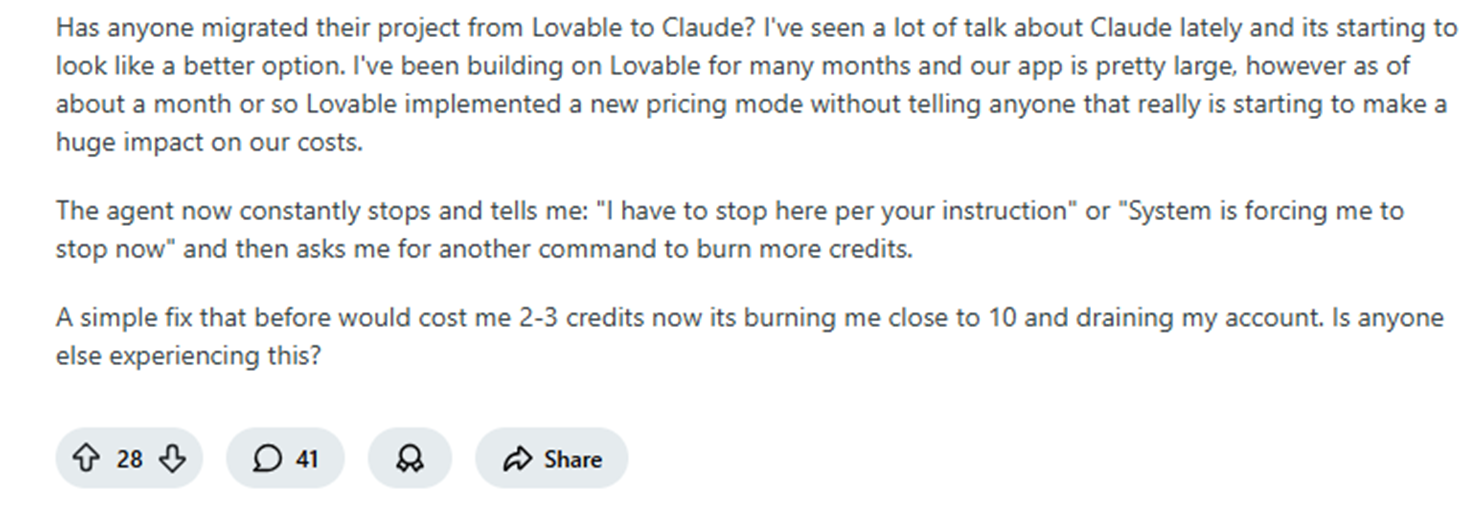
One user shared that after months of building on the platform, the platform’s pricing model changed, and simple fixes that previously cost 2–3 credits started burning close to 10. The AI agent also constantly stopped mid-task to trigger additional credit usage.
2. Debugging loops that drain your balance
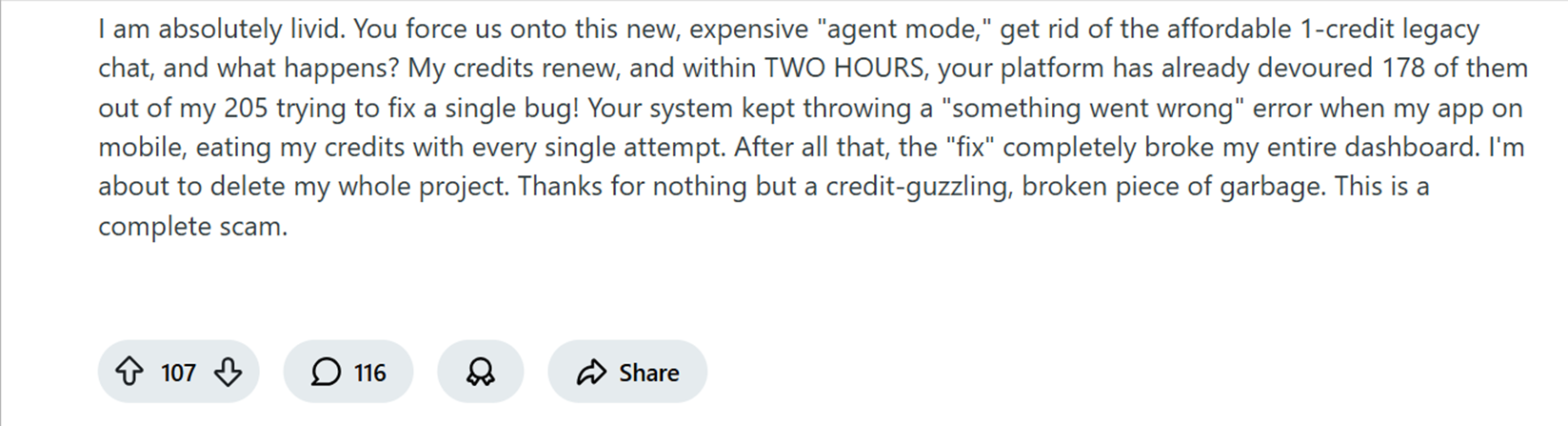
Some users report a frustrating pattern: the AI attempts to fix a bug, creates a new one, then cycles through fixes that waste credits without resolving the original issue. Each iteration incurs a credit cost, and the user has no control over the AI’s approach. This is especially problematic for teams working against deadlines.
3. Apps aren't production-ready
It’s been noted by users that Lovable’s prototype-quality code and production-grade software are usually not the same thing. These apps may be functional enough for demos, but they lack the security, scalability, and maintainability required for real-world applications.
Teams building anything beyond a basic MVP often find themselves rewriting significant portions of the codebase or migrating to a different stack entirely. That rewrite cost isn’t reflected in Lovable’s pricing page.
4. Third-party service costs add up
Lovable relies on Supabase for backend functionality. While the integration is convenient, production applications typically require paid Supabase hosting, additional security configurations, and potentially other third-party services for payments, analytics, or monitoring. These costs are separate from your Lovable subscription and can add up quickly.
5. Limited support for paid users
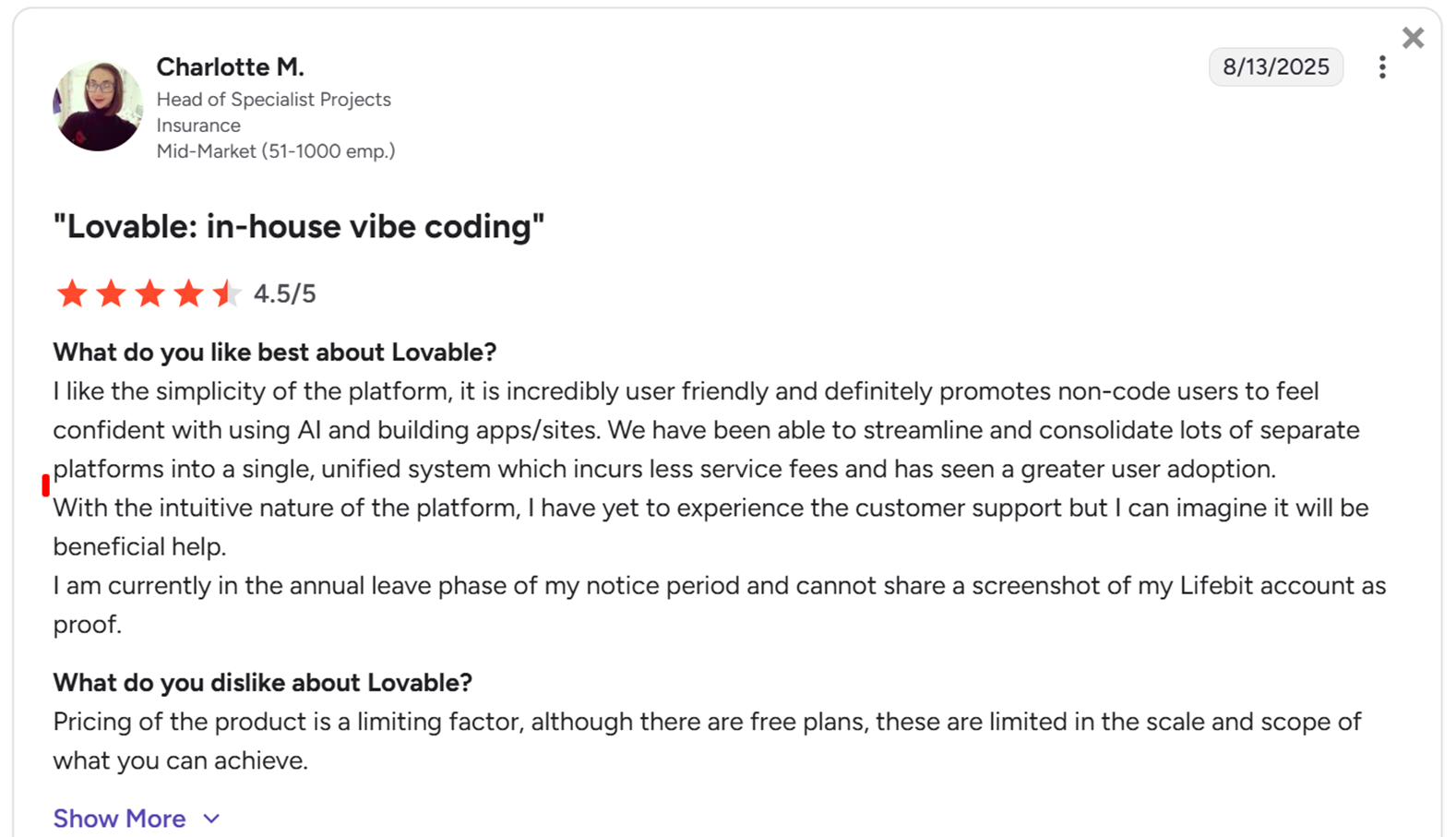
Several reviews highlight inconsistent support experiences, even on paid plans. For teams that need reliable assistance when builds go sideways, this gap can slow development and increase frustration, especially when credits are being consumed.
Why Launchpad is the better choice for serious software teams
If your goal is to build, ship, and scale an enterprise B2B software product, Launchpad solves the problems that Lovable can't.
1. Production-ready from day one
Unlike Lovable, which requires rebuilding prototypes for production, Launchpad applications are enterprise-grade from the start. The platform includes a built-in multitenant architecture, security (SOC 2, ISO 27001, GDPR, HIPAA-compliant), and fully managed, scalable cloud infrastructure. You ship real software, not demos that need rewiring.
2. Predictable, usage-based pricing that scales with you
Launchpad uses an AWS-style, usage-based pricing model built around Launchpad Units (LPUs). You start free with Launchpad Explore and GenAI Blueprint, then move to low-cost subscription plans as you scale. There are no credit ceilings, no per-prompt charges, and no surprise costs from AI debugging loops. Your costs scale with your success, not just because you made a mistake during construction.
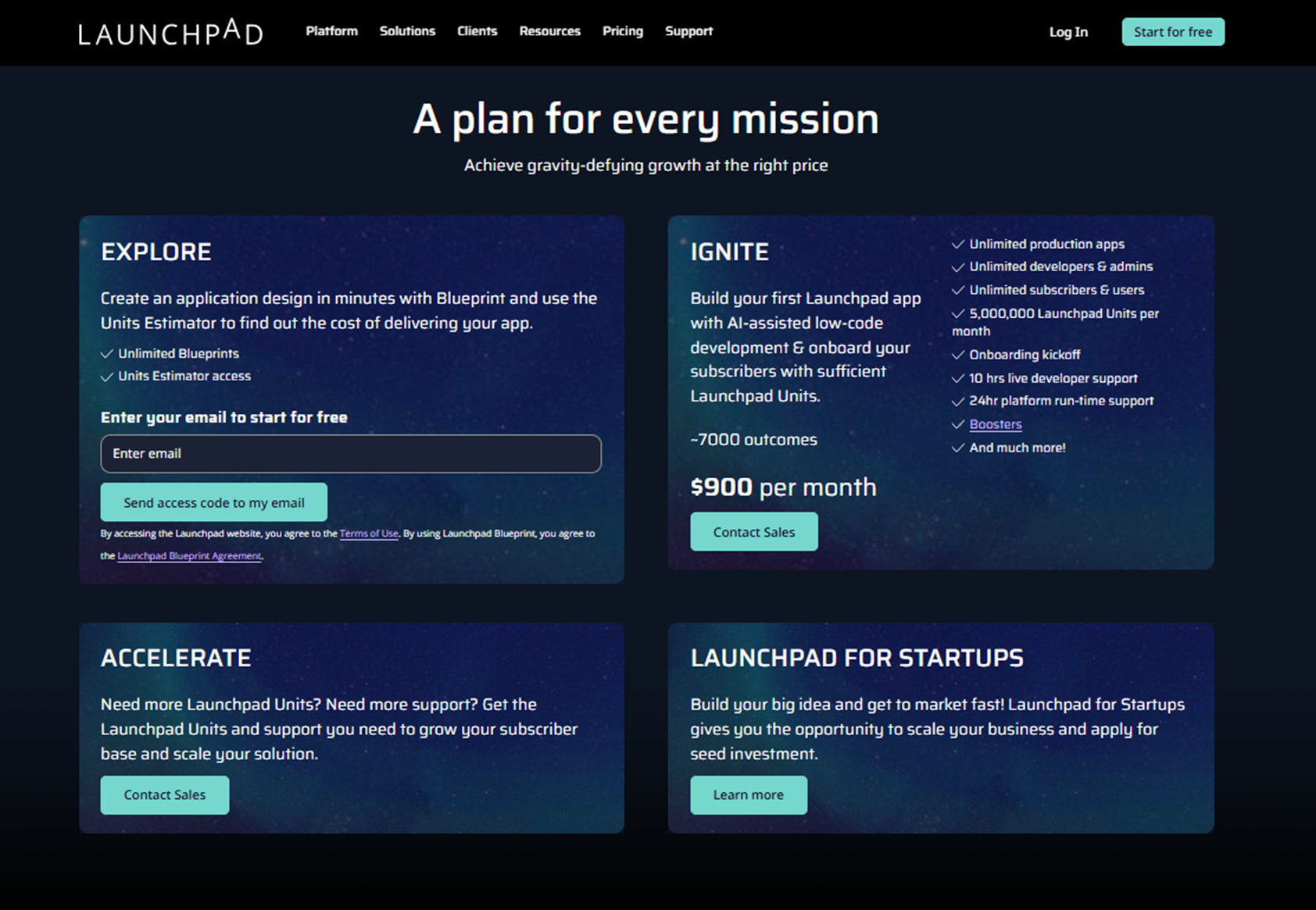
3. Built for B2B software companies, not just prototypers
Lovable is a general-purpose AI builder. Launchpad is purpose-built for software companies building products they can sell. With robust workflow automation (powered by Pega's 40 years of orchestration expertise), AI integrations, pre-built APIs, and ready-made UX design, Launchpad helps teams focus on their IP and differentiation.
4. Proven results, not just promises
Fielo reduced development time from three sprints to half a sprint by using Launchpad and now serves enterprise clients such as Google and Audi. Quavo grew platform revenue by 25x. These are real production applications delivering real business outcomes.
5. Automations that streamline your workflow
Launchpad offers workflow automation as a core feature. You can design your automation workflow to automate repetitive tasks. You don't need to write custom backend code for each flow; it automatically builds the logic into your product. Whereas on Lovable, you'll need to build from scratch or integrate third-party tools.
Lovable vs. Launchpad: a direct comparison
Let’s take a look at how Launchpad stacks up against Loveable:
|
# |
Category |
Lovable |
Launchpad |
|
1 |
Primary use case |
Prototyping and MVPs |
Production-grade B2B software |
|
2 |
Pricing model |
Credit-based (unpredictable) |
Usage-based, AWS-style (predictable) |
|
3 |
Production readiness |
Requires significant rework |
Enterprise-grade from day one |
|
4 |
Infrastructure |
Relies on third-party services |
Fully managed cloud, database, and DevOps |
|
5 |
Security & compliance |
Basic |
SOC 2, ISO 27001, GDPR, HIPAA |
|
6 |
Workflow automation |
None |
Built-in (Pega's 40-year orchestration engine) |
Building software that lasts with Launchpad
Lovable is a capable tool for what it's designed to do: generate quick prototypes and validate ideas fast. It’s a good solution for non-technical founders testing a concept or solo builders who need a demo in hours rather than weeks. But when the credit-based model, production-readiness gaps, and unpredictable costs become serious roadblocks, it creates a discrepancy.
Launchpad takes a fundamentally different approach. Instead of generating throwaway prototypes, it gives software teams the infrastructure, AI capabilities, and workflow automation they need to build and ship real products from day one. Sign up for Launchpad for free and start building production-ready software without the credit anxiety.
About the Author
Kat Austin works in product marketing for Launchpad, helping companies understand how AI-powered software can automate work, deliver measurable outcomes, and bring new solutions to market faster.