

Quick summary
Mendix offers three pricing tiers: Free, Standard, and Premium, with a base platform fee plus per-user costs on every app you build. But it comes with hidden charges, which can stack up on the listed plans. So, you must learn what each Mendix plan includes, where the extra charges surface, and why Launchpad offers a more predictable path for teams building commercial software.
Considering Mendix for your next B2B product?
Mendix is one of the most recognized enterprise low-code platforms on the market, backed by Siemens. The visual IDE, reusable component marketplace, and multi-cloud deployment options are real strengths. But the pricing page only tells part of the story.
What looks like a straightforward three-tier structure conceals per-user fees, separately billed infrastructure, and enterprise feature add-ons that stack on top of the listed price. For B2B software companies whose user counts grow with customer adoption, that changes the math entirely.
So, this guide walks through what Mendix costs at each level and explains how a production-first platform compares for commercial software teams.
Why listen to us?
At Launchpad, we help B2B enterprise software companies turn ideas into products that their customers depend on. Our platform is built on Pegasystems’ four decades of enterprise workflow automation, which means the infrastructure behind your application has already been stress-tested at scale.
Companies like Fielo, Quavo, and Connex run production software on Launchpad today. Working with teams that evaluate platforms such as Mendix and others regularly gives us direct insight into pricing models, and platform limitations. We understand what it actually takes to build scalable enterprise SaaS products.
With Launchpad, I created a product in about a month that would’ve taken six months to a year with a full stack team.
-Joseph Anderson, CEO, Connex
What Is Mendix and who is it built for?
Mendix is a low-code development platform that lets teams build web, mobile, and progressive web apps through a visual interface. Instead of hand-coding every layer, Mendix Studio Pro acts as the main development environment. Developers use it to define data models, design UI screens, and configure workflows by dragging and connecting components. When the visual tools aren’t enough, you can extend applications with custom Java or JavaScript.
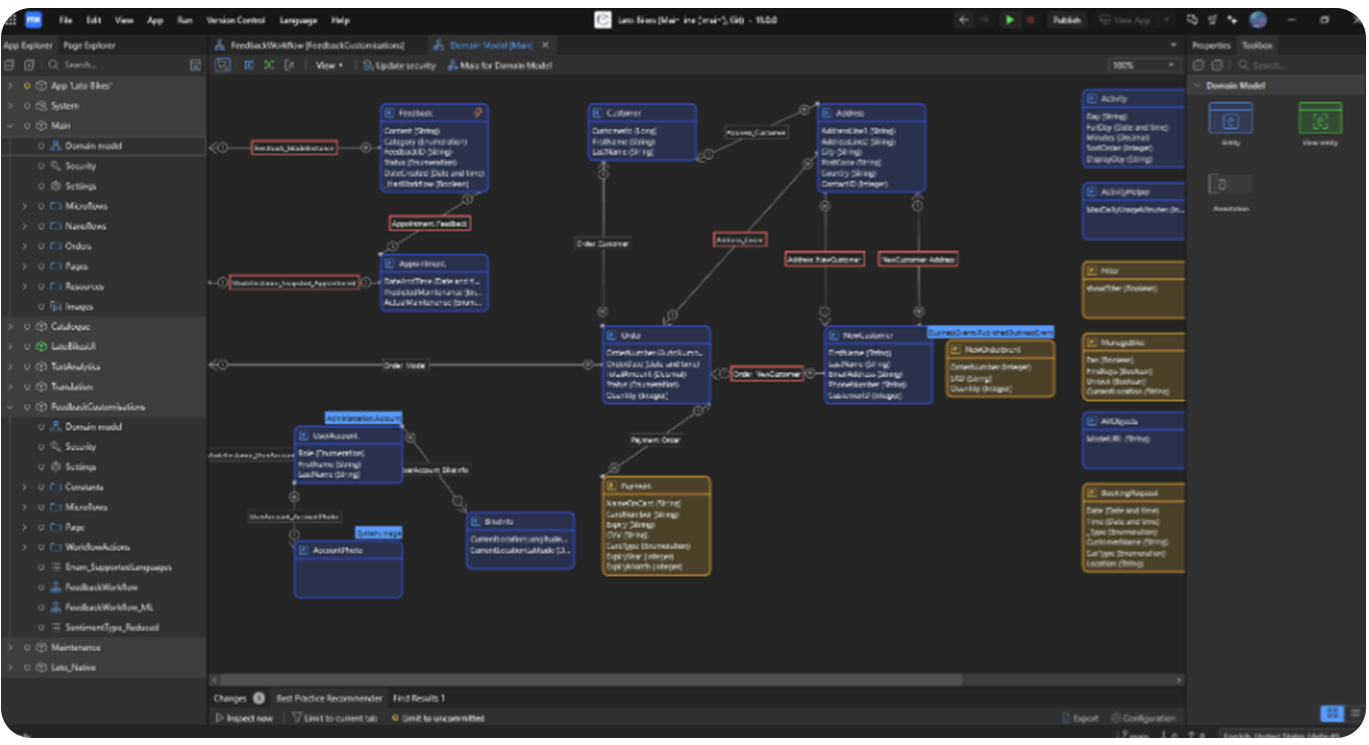
The Atlas UI framework provides pre-built design patterns, while the Mendix Marketplace offers modules, widgets, and connectors. Deployment spans Mendix’s own cloud (on AWS), private Kubernetes clusters, SAP BTP, and on-premises servers.
Most Mendix customers are large enterprises building internal tools, employee portals, or legacy system replacements. Mendix also runs an ISV program for software vendors building commercial products, though that program operates on royalty-based terms negotiated through sales.
Mendix pricing plans compared
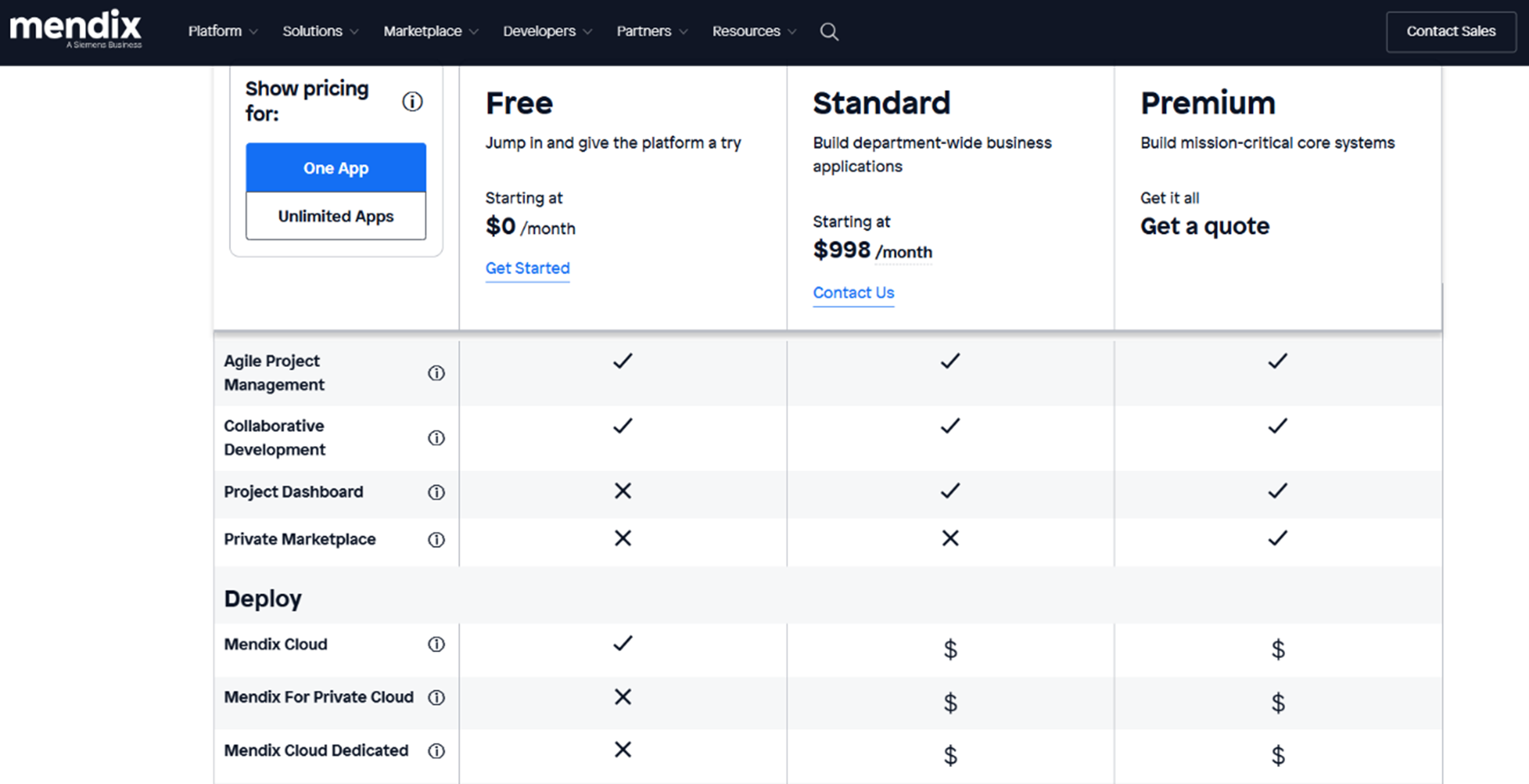
Mendix organizes its pricing into two tracks: One App and Unlimited Apps. The platform capabilities are identical across both tracks. The only difference is the base license cost. Here’s what each tier costs:
|
# |
Plan |
One App Price |
Unlimited Apps Price |
Per-User Add-On |
Best For |
|
1 |
Free |
$0 per month |
$0 per month |
None |
Prototyping and exploration |
|
2 |
Standard |
$998 per month |
$2,495 per month |
+ per-user fee per app, per month (5 users included) |
Department-wide business applications |
|
3 |
Premium |
Get a Quote |
Get a Quote |
+ per-user fee per app, per month (5 users included) |
Mission-critical core systems |
Breakdown of each Mendix pricing tier
1. Free Plan: $0/month
Mendix’s Free tier gives you full access to the IDE, agile project management, and collaborative development. You get two environments. One for local development and another for production environment on Mendix Cloud with a shared database and unlimited users. There’s no credit card required and no time limit.
Support at this level is community-only through the Mendix forum, and there’s no uptime guarantee. It’s a genuine free tier for exploring the platform and building small personal projects or demos.
But with a shared database, no SLA, and no customer support, it’s not a viable foundation for anything you plan to put in front of paying customers.
2. Standard Plan: Starting at $998/month (one app) or $2,495/month (unlimited apps)
Standard is where Mendix’s pricing model becomes considerably more layered. The base license starts at $998/month for a single app or $2,495/month for unlimited apps. On top of that, you’ll pay a per-user fee per app, per month, after the first five users are covered.
This plan includes dedicated databases and up to four environments per app. It also provides project and operations dashboards, IDP integration, vertical scaling, a customer success manager, 9 AM–5 PM support, and a 99.5% uptime SLA. These are meaningful upgrades that make Standard the baseline for any serious business application.
However, every cloud deployment option is listed as an additional cost. Mendix states in its FAQ that Standard and Premium licenses do not include compute resources. The $998/month is the platform fee alone, and the infrastructure is negotiated and invoiced separately.
3. Premium Plan: get a quote
Premium is Mendix’s top tier, and there’s no listed price. It adds:
- horizontal scaling.
- high-availability with fallback.
- multi-region failover.
- a private marketplace.
- advanced infrastructure controls.
- flexible environments.
- 24/7 support with a 99.95% uptime SLA.
The per-user cost also increases at this level compared to Standard. But even within Premium, horizontal scaling, HA/fallback, and multi-region failover are each flagged as separate additional costs. So, the custom quote you receive is a starting point for negotiation, not the final number.
4. ISV Program
Mendix makes clear on its pricing page that the listed plans are for enterprises building internal applications. If you’re an ISV building a commercial product, a separate royalty-based program applies.
The royalty rate and partnership terms are negotiated with Mendix’s ISV sales team. This means you can’t model unit economics without first entering a sales conversation.
Features of Mendix
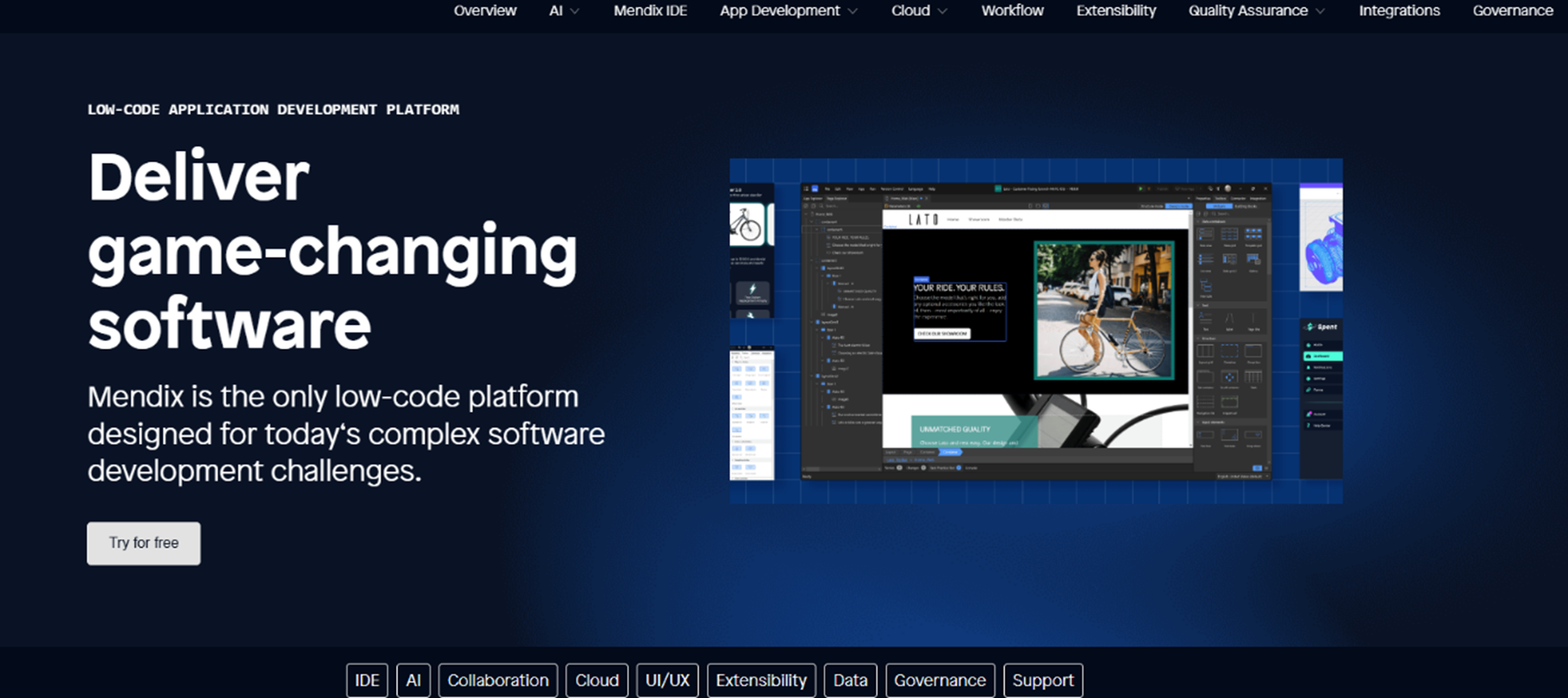
Pricing complexity aside, Mendix delivers a capable development environment. Here’s what draws organizations to the platform:
1. Visual Development and Marketplace
Mendix Studio Pro lets teams build applications by visually defining data models through microflows and nanoflows rather than writing procedural code. The Mendix Marketplace adds reusable widgets, modules, and connectors built by Mendix and its partners. For standard business applications, this combination compresses development timelines considerably.
2. Multi-cloud deployment and AI capabilities
Mendix supports six deployment options:
- Mendix Cloud.
- Private Kubernetes clusters.
- Mendix Cloud Dedicated.
- AWS GovCloud.
- SAP BTP.
- On-premises servers.
The platform also integrates AI through Mendix Assist for logic suggestions and performance recommendations. But the trade-off is that each deployment option beyond the Free tier comes with its own separately negotiated cost.
Hidden costs and pricing limitations of Mendix
The sticker prices on Mendix’s pricing page are just the first layer. Here’s where the actual costs diverge:
1. Cloud infrastructure is an entirely separate bill
On Standard and Premium plans, the base license covers only the development platform. The compute resources your applications need are billed separately. Mendix confirms this in its FAQ. For teams accustomed to platforms where hosting is bundled, this separate infrastructure negotiation is an unwelcome surprise.
2. Per-user pricing penalizes customer growth
Mendix charges per user, per app, per month on both Standard and Premium tiers, with five users included in the base. It defines a user as any individual who has access to your application. But anonymous users and developers are not counted.
For internal tools with fixed headcounts, this is manageable. However, for B2B software companies building customer-facing products, it creates a structural problem, where every new customer increases your Mendix bill.
Mendix says the per-user price decreases as volume grows and that they offer more attractive pricing for external-user scenarios like B2B portals. But the specific discounts aren’t published.
3. Enterprise essentials are priced as add-ons, even on premium
Horizontal scaling, high availability with fallback, and multi-region failover are all marked as additional-cost items on the Premium plan. These aren’t nice-to-haves for production applications serving real customers, but requirements. However, Mendix treats them as upsells.
4. The ISV royalty model ties your margins to Mendix
Software companies building products for sale use Mendix’s ISV program rather than standard plans. This program takes a royalty cut of your product revenue. As your revenue grows, this royalty can become one of your largest cost-of-goods-sold line items, and it’s one you have limited ability to renegotiate.
5. Vendor lock-in through proprietary architecture
Mendix applications run on a proprietary runtime using visual models that don’t translate to standard codebases. The Mendix SDK offers programmatic model access, but moving off Mendix practically means rebuilding application logic.
For B2B software companies making a multi-year commitment, this lock-in amplifies every other pricing concern. That’s because switching costs make it harder to walk away if terms become unfavorable.
Why Launchpad is the better foundation for B2B software companies
Mendix was designed to help large enterprises build internal applications faster. Whereas Launchpad was designed for software companies that need to build, sell, and grow commercial products. Here’s why it stands out:
1. Infrastructure, security, and compliance are included
Launchpad runs on a fully managed, multitenant cloud architecture with SOC 2, ISO 27001, GDPR, and HIPAA compliance built in. Auto-scaling, database management, DevOps, and security are part of the platform and not separate invoices that arrive after your license fee.
2. No per-user fees that scale against you
Launchpad uses an AWS-style, consumption-based pricing model built around Launchpad Units (LPUs). Your costs scale with actual platform usage, not with how many people access your application.
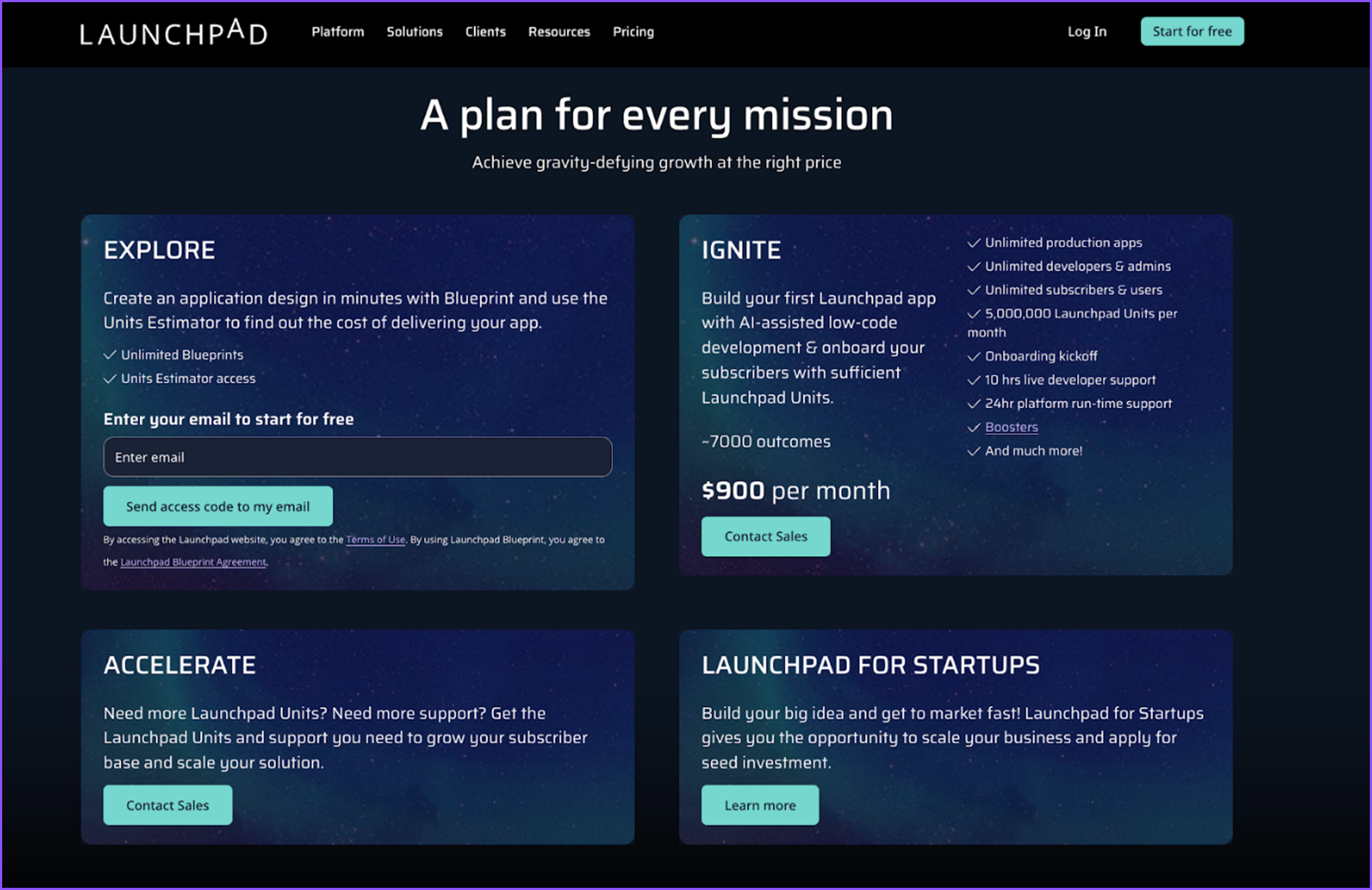
When your customer base grows from 50 to 500 users, your platform bill doesn’t spike in response. You can start free with Launchpad Explore, then scale to paid plans starting at $900/month.
3. No royalty agreements on your revenue
Unlike Mendix’s ISV program, Launchpad doesn’t take a percentage of the revenue your software generates. You pay for the platform you use.
What you charge your customers, and what you keep, is entirely up to you. That means full control over your margins and pricing strategy without a vendor sharing in every transaction.
4. Purpose-built for commercial B2B software
Mendix serves a wide range of enterprise use cases. Whereas Launchpad focuses specifically on commercial B2B software. Built-in multi-tenant architecture, subscriber management, Pega-powered workflow orchestration, and pre-built APIs provide the foundations every enterprise SaaS product needs without spending months assembling them from scratch.
5. Results from real software companies
Fielo cut development cycles from three sprints to half a sprint after moving to Launchpad and now delivers enterprise-grade solutions for clients, like Google and Audi. While Quavo grew platform revenue by 25x. These results came from a platform engineered for the demands of commercial software.
Something that could take two or three sprints to do, we can now do in half a sprint.
-Sanjay Agarwal, Founder & CEO, Fielo
Mendix vs. Launchpad: a direct comparison
|
# |
Category |
Mendix |
Launchpad |
|
1 |
Primary use case |
Internal enterprise applications and portals |
Commercial B2B software products |
|
2 |
Pricing tiers |
Free, Standard ($998+ per month), Premium (custom quote) |
Free Explore tier, then usage-based from $900 per month |
|
3 |
Per-user costs |
Per-user / app / month fee on Standard and Premium |
No per-user fees; scales with consumption |
|
4 |
ISV / commercial pricing |
Royalty-based ISV program (privately negotiated) |
No royalties; pay for platform usage only |
|
5 |
Cloud infrastructure |
Billed separately on Standard and Premium |
Fully managed cloud, database, and DevOps included |
|
6 |
Security and compliance |
Varies by plan; HA, failover are paid add-ons even on Premium |
SOC 2, ISO 27001, GDPR, HIPAA included |
|
7 |
Workflow automation |
Available (Mendix workflow engine) |
Built-in Pega workflow orchestration (40-year engine) |
When the platform fee is just the beginning
Mendix has earned its position as a respected enterprise low-code platform. For large organizations building internal applications with predictable user counts and existing cloud contracts, it delivers real value.
The calculus shifts for B2B software companies building products they sell. When your platform bill grows with every new customer, cloud hosting is a separate negotiation. High availability is an add-on even on the top tier, and an ISV royalty permanently shares your revenue. Thus, the total cost of ownership starts to work against the business model you’re trying to build.
But Launchpad takes a different approach. It includes a production-grade infrastructure, usage-based pricing that doesn’t penalize adoption, zero royalty arrangements, and a platform specifically engineered for commercial B2B software.
So, sign up with Launchpad for free and build software that scales with your revenue, not against it.
Frequently Asked Questions
How much does Mendix cost per month?
Mendix has three pricing tiers. Free costs $0/month. Standard starts at $998/month for one app or $2,495/month for unlimited apps. While Premium requires a custom quote. On top of these base fees, Standard and Premium plans charge per-user fees and bill cloud infrastructure separately.
Does Mendix charge per user?
Yes. On both Standard and Premium plans, Mendix charges a per-user fee per app per month, with the first five users included in the base price. Mendix states that per-user pricing decreases as volume grows and offers more attractive rates for external-user scenarios, but specific discounts require direct negotiation.
Does Mendix pricing include cloud hosting?
Only on the Free plan. On Standard and Premium, Mendix explicitly does not include compute resources in the license price. Cloud infrastructure costs are determined separately based on your deployment model and negotiated with Mendix or your hosting provider.
What is the Mendix ISV program?
The Mendix ISV program is for software vendors building commercial products on the platform. Instead of the standard pricing tiers, ISVs pay a royalty based on product revenue. Terms are negotiated privately with Mendix’s ISV sales team.
How does Launchpad’s pricing compare to Mendix's?
Launchpad uses a consumption-based model (Launchpad Units) with no per-user fees and no revenue royalties. Infrastructure, security, compliance, and DevOps are included in the platform. You start free with the Launchpad Explore and scale to paid plans starting at $900/month.
About the Author
Kat Austin works in product marketing for Launchpad and helps companies of all sizes understand how to use SaaS to innovate and grow revenue faster than ever before.