

Quick summary
Replit offers a cloud-based IDE with AI coding assistance for developers prototyping and learning, while Lovable generates full applications from prompts for non-technical founders creating demos. The article breaks down their key differences in features, pricing, and production readiness to help B2B software teams
Struggling to choose between Replit and Lovable?
If you're comparing Replit and Lovable, chances are you’re looking for a solution to ship software products faster for your clients without expanding your engineering team.
Both platforms promise AI-powered development, but they work differently. Replit gives developers an AI-assisted IDE for writing code. Lovable generates entire applications from prompts.
The challenge is knowing which one actually delivers production-ready software you can sell to customers, not just demos that need complete rebuilds before launch.
This article breaks down how Replit and Lovable differ in features, pricing, infrastructure, and production readiness so you can pick the right platform for your needs.
Why listen to us?
At Launchpad, we've helped B2B software companies build and ship production-ready applications on Pega's 40-year workflow orchestration platform. Our platform helps companies like Fielo achieve 50%+ faster development while serving enterprise clients such as Google and Audi. This gives us insight into where AI code builders like Replit and Lovable work well and where they fall short for teams building scalable B2B software.
Why Launchpad?
It was love at first sight - the idea of a low-code platform that's got a lot of what we need already built in and that enables faster development cycles and takes care of all the heavy lifting.
-Sanjay Agarwal, Founder & CEO, Fielo
Replit vs Lovable: quick differences
Here's a quick comparison to help you decide which platform fits your B2B software needs:
|
# |
Feature |
Replit |
Lovable |
|
1 |
Ideal For |
Developers who code, learning environments |
Non-technical builders, rapid prototyping |
|
2 |
Development Approach |
Code-first IDE with AI assistant |
AI generates full apps from prompts |
|
3 |
Code Output |
You write code with AI help |
AI generates React + Tailwind CSS |
|
4 |
Learning Curve |
Requires coding knowledge |
No coding required |
|
5 |
Production-Ready |
No, basic hosting lacks enterprise features |
No, prototypes need significant work for production |
|
6 |
Hosting |
Included (basic) |
Via Supabase or export code |
|
7 |
Collaboration |
Real-time multiplayer coding (up to 5 on Core, 15 on Pro) |
Unlimited collaborators on all plans |
|
8 |
Pricing |
$20 per month (Core) with credit-based usage |
$25 per month (Pro) with credit-based usage |
|
9 |
Best Use Case |
Prototyping with code control |
Fast UI demos and concept validation |
Bottom Line: Choose Replit if you're a developer who wants AI coding assistance within a full IDE. Choose Lovable if you need to generate app prototypes from descriptions without writing code.
What Is Replit?
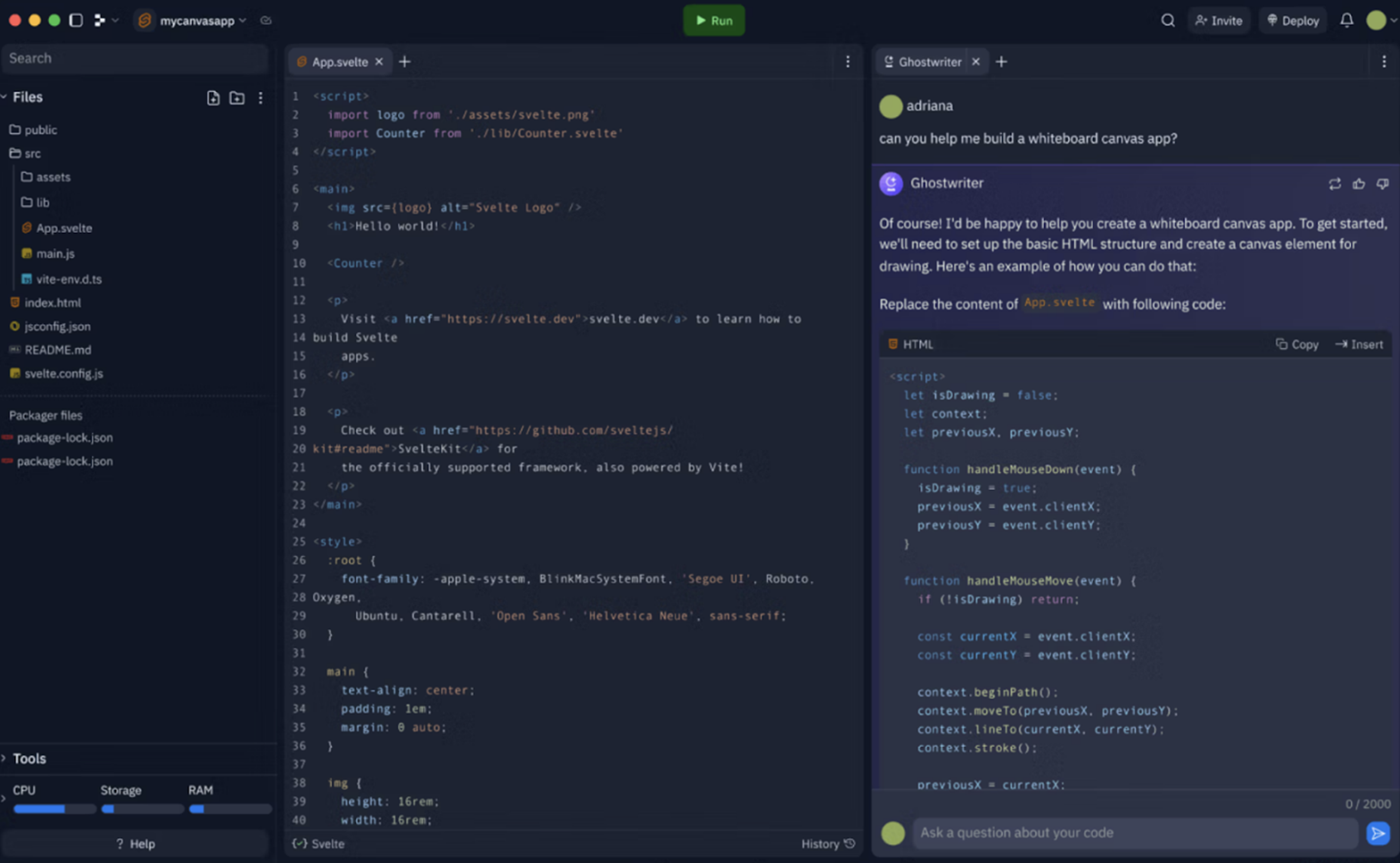
Replit is a cloud-based integrated development environment (IDE) that lets developers write, run, and deploy code directly in the browser. Replit Agent provides AI coding assistance and is designed for developers prototyping projects, students learning programming, and teams collaborating on code without a local setup.
Some teams look for Replit Alternatives because, while Replit accelerates coding, teams are still responsible for architecting infrastructure, managing scalability, and building core SaaS components like multitenancy and billing from scratch.
Replit key features
- Browser-based IDE: Write and run code in 50+ programming languages without installing anything locally
- Replit Agent: AI assistant that generates code, debugs, explains errors, and builds features from natural language prompts
- Real-time collaboration: Multiplayer coding with up to 5 people on the Core plan, 15 on the Pro plan
- Instant deployment: Deploy web apps with one click, including autoscale and reserved VM options
- Built-in database: PostgreSQL database integration and secrets manager included
- GitHub integration: Sync repositories for version control and team workflows
- Mobile app development: New capability to build and publish mobile apps using natural language (launched January 2026)
Replit pricing
Core plans
- Starter: Free; free daily Agent credits, free credits for AI integrations, publish 1 app, limited Agent intelligence
- Replit Core: $20/month (billed annually); $25 monthly credits, access to the latest models, publish and host live apps, autonomous long builds, remove "Made with Replit" badge, pay-as-you-go for additional usage
- Teams: $35/user/month (billed annually); everything in Core, $40/month usage credits per user, upfront credits on annual plan, 50 viewer seats, centralized billing, role-based access control, private deployments
- Enterprise: Custom pricing; everything in Teams, custom viewer seats, SSO/SAML, SCIM, advanced privacy controls, design system support, data warehouse connections, dedicated support
Additional costs
- Usage-Based Pricing: Costs beyond included credits vary by deployment type and AI usage
- Deployment Options: Autoscale deployments, reserved VM deployments, scheduled deployments (fees apply beyond free tier)
Replit Pros
- Fast setup with zero local environment configuration needed
- Strong for educational purposes and teaching programming concepts
- Real-time collaboration makes pair programming and team coding seamless
- Active community with templates and quick-start projects
- Supports 50+ languages for polyglot development
- Agent 3 AI can autonomously debug, add error handling, and write tests
- GitHub integration for professional version control workflows
Replit Cons
- You're still writing code, which doesn't fundamentally accelerate non-developers
- No enterprise-grade infrastructure (multitenancy, SOC2/HIPAA compliance, production scalability)
- No sophisticated workflow orchestration or business process automation
- Apps aren't designed for commercial B2B deployment at scale
- Usage costs can escalate quickly with AI features and always-on deployments
- An agent can get confused on complex tasks or stuck in loops
- The interface can feel overwhelming with multiple panels open simultaneously
- Requires developer expertise to troubleshoot when AI assistance falls short
What Is Lovable?
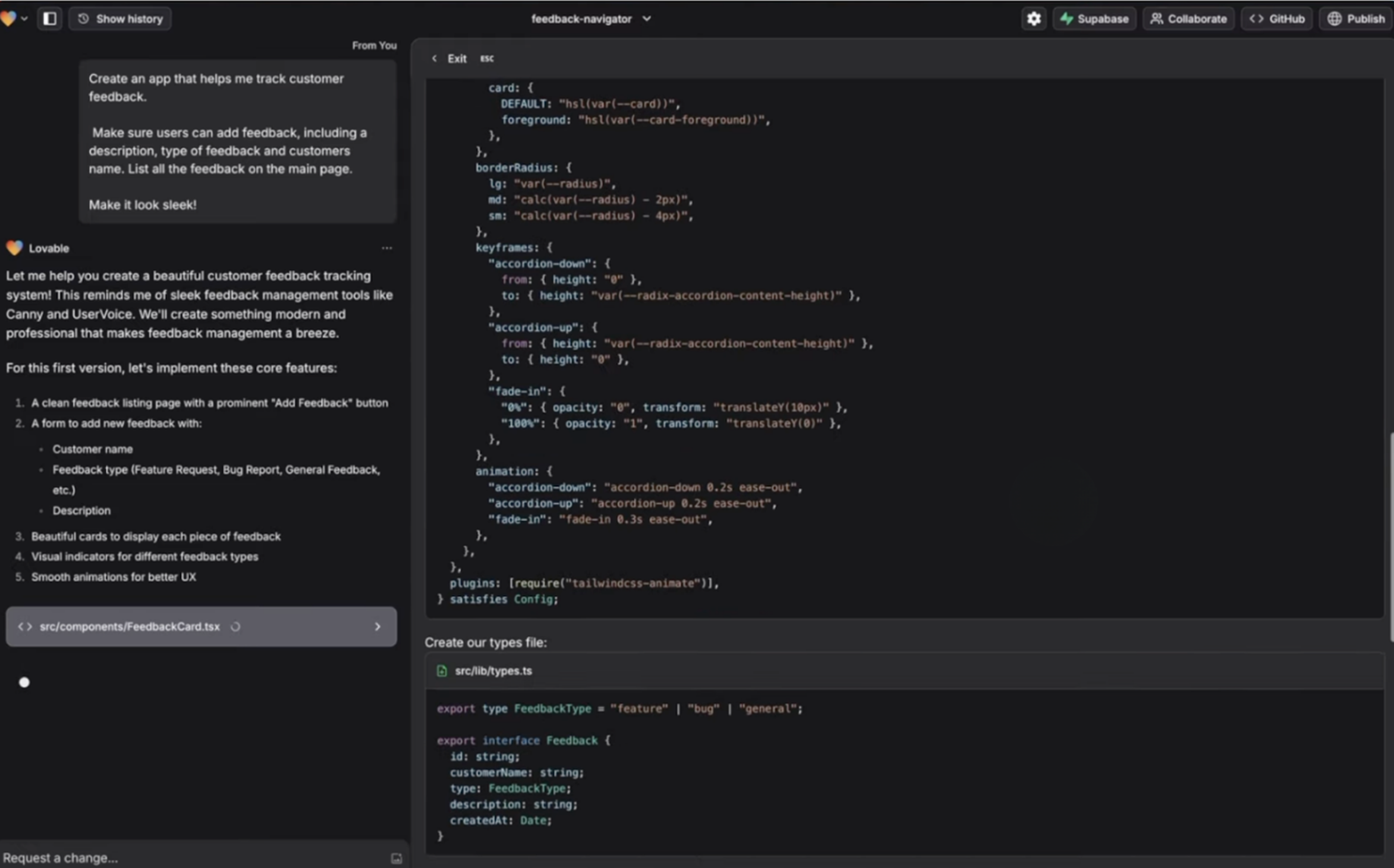
Lovable is an AI-powered app builder that generates full-stack web applications from natural language prompts. Instead of writing code, users describe what they want, and Lovable creates React components with Tailwind CSS styling. It's designed for non-technical founders, product teams, and designers who need to build prototypes and validate concepts quickly.
Some teams who have used the platform typically seek Lovable alternatives because applications generated typically require significant refactoring and infrastructure rebuilds before they can support real customers at scale.
Lovable key features
- Natural language app generation: Describe your app in plain English, and AI generates working React code
- Credit-based system: Each AI action (prompts, code generation, edits) consumes credits based on complexity
- Visual component editor: Modify generated UI elements without coding
- Supabase integration: Built-in database, authentication, and backend services
- GitHub sync: Export and sync code to repositories for developer handoff
- Real-time preview: See changes immediately as features are described
- Unlimited collaborators: All plans support unlimited team members viewing and contributing
- Custom domains: Connect your own domain on paid plans
- Multiple AI models: Choose between Gemini, GPT, and other models for different tasks
Lovable pricing
Core plans
- Free: $0/month; 5 daily credits (up to 30/month), public projects, unlimited collaborators, 5 lovable.app domains, cloud hosting
- Pro: $25/month (shared across unlimited users); 100 monthly credits, 5 daily credits (up to 150/month), usage-based Cloud + AI, credit rollovers, on-demand credit top-ups, unlimited lovable.app domains, custom domains, remove Lovable badge, user roles and permissions
- Business: $50/month (shared across unlimited users); 100 monthly credits, all Pro features, internal publish, SSO, team workspace, personal projects, design templates, role-based access, security center
- Enterprise: Custom pricing; all Business features, dedicated support, onboarding services, design systems, SCIM, support for custom connectors, publishing controls, sharing controls, audit logs
Additional costs
- Credit-Based System: Each AI action (prompts, code generation, edits) consumes credits based on complexity
- Usage Scaling: Real-world costs can reach $200-500+/month for active development as credits are consumed through iterations
Lovable Pros
- No coding knowledge required for basic app building
- Generates clean, modern UI designs automatically
- Good for investor demos and concept validation
- Supabase integration provides a backend out of the box
- Export code for further customization by developers
- Unlimited collaborators make stakeholder feedback easy
- Fast iteration cycles for testing ideas with users
Lovable cons
- Apps are prototypes, not production-ready for commercial use
- No enterprise security, compliance (SOC2/HIPAA), or multitenant architecture
- No sophisticated workflow automation or business logic orchestration
- Scalability issues with real user loads and complex data requirements
- Limited customization beyond generated React/Tailwind code
- No built-in subscriber management or SaaS infrastructure (billing, usage tracking, admin)
- AI can "hallucinate" and incorrectly report bugs as fixed
- Struggles with backend complexity and advanced features
- Requires a complete rebuild by the dev team to make production-capable
- Generated code quality varies and often needs significant refactoring
Launchpad: enterprise-grade platform for building and shipping AI-powered software
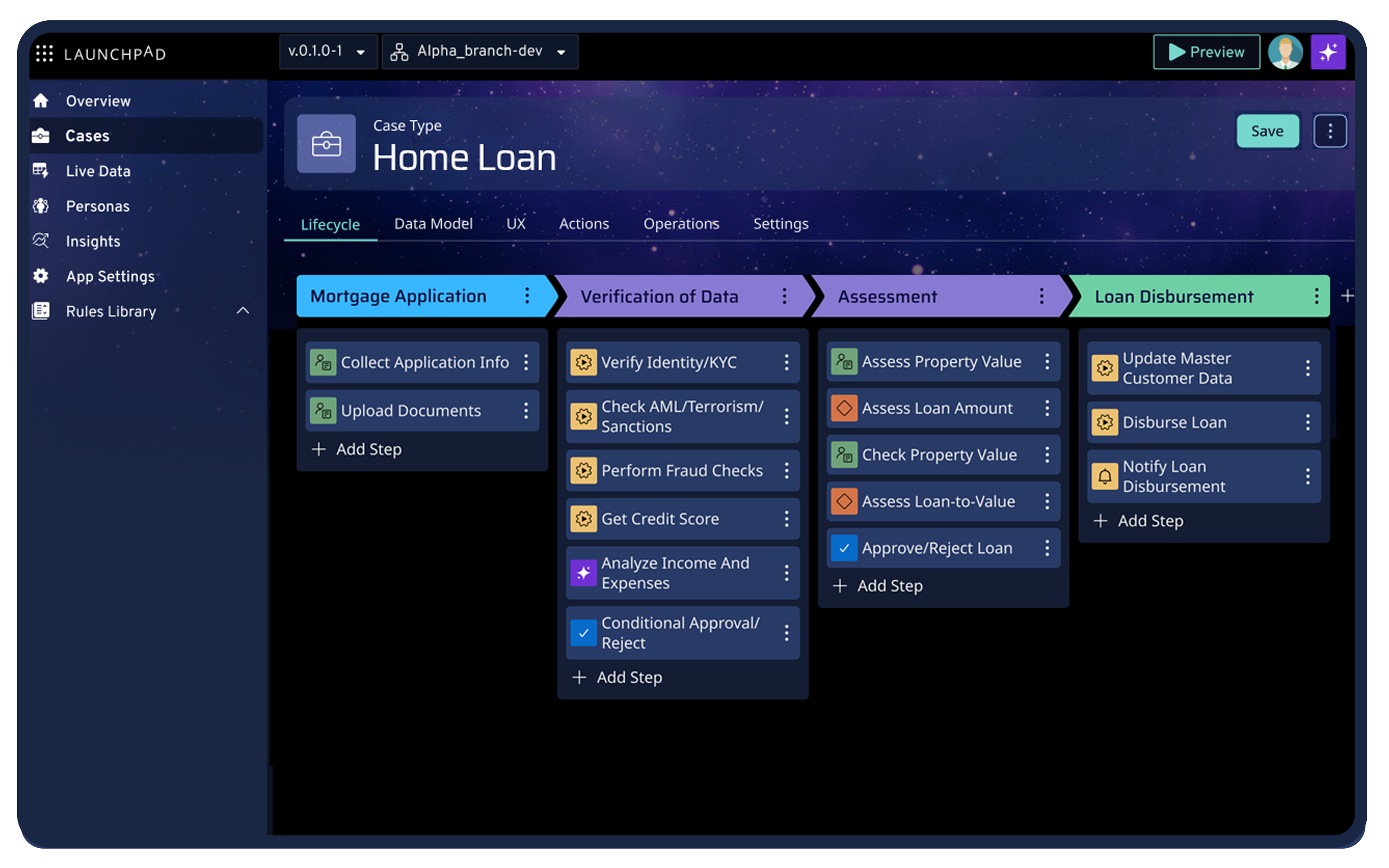
Replit and Lovable are capable tools for rapid prototyping and learning to code. But B2B software companies don't need more prototypes. You need production-ready applications that customers will pay for, with enterprise infrastructure and agentic workflows built in from day one.
Launchpad addresses this gap by combining no-code development with production-ready, enterprise-grade infrastructure. Instead of building impressive demos that require complete rebuilds, you're creating sellable software products on a platform trusted by the world's largest companies for 40 years.
Launchpad key features
- AI-powered GenAI Blueprint: Creates app blueprints from natural language prompts, with built-in guidance for workflow automation, UX design, integrations, reporting, and insights.
- Built-in subscriber management: Administration portal with configuration, identity management, and usage reporting included.
- Native multi-tenancy support: Strict cross-tenant separation via isolated Firecracker environments within dedicated AWS accounts for true enterprise security.
- Fully managed runtime: Hosted on AWS with MongoDB database, handling DevOps and CloudOps so you focus on building differentiation, not infrastructure.
- Visual workflow builder: Drag-and-drop UI components and pre-built elements for rapid application development without code.
- Flexible integration options: Connect to any REST API or existing integration, AWS Lambda support for custom logic, no vendor lock-in.
- AI integration: Amazon Bedrock integration with models like Claude, no manual API setups required for adding AI capabilities to your applications.
Launchpad pricing
Launchpad uses a usage-based model similar to AWS. The average contract value starts at $900/month currently. There's a free tier (Explore) for exploration and prototyping.
Replit vs Lovable vs Launchpad: side-by-side comparison
|
# |
Feature |
Replit |
Lovable |
Launchpad |
|
1 |
Ideal For |
Developers learning / prototyping |
Non-technical builders, rapid demos |
B2B software companies building products to sell |
|
2 |
Development Approach |
Code-first IDE with AI assistant |
AI generates full apps from prompts |
AI-powered low-code with GenAI Blueprint |
|
3 |
Code Output |
You write code with AI help |
AI generates React + Tailwind CSS |
Model-driven applications with enterprise runtime |
|
4 |
ProductionReady |
No, basic hosting only |
No, requires rebuild for production |
Yes, enterprise-grade from day one |
|
5 |
Multi-Tenancy |
Not supported |
Not supported |
Native multi-tenant architecture with cross-tenant isolation |
|
6 |
Workflow Automation |
None |
Basic UI automation |
Workflow orchestration (Pega's 40-year technology) |
|
7 |
Infrastructure |
Basic cloud hosting |
None (requires Supabase or export) |
Fully managed runtime on AWS with MongoDB |
|
8 |
Subscriber Management |
Build yourself |
Build yourself |
Built-in portal with admin, identity, usage reporting |
|
9 |
Security & Compliance |
Basic |
Basic |
Enterprise-grade certifications and compliance frameworks |
|
10 |
Scalability |
Limited |
Not designed for scale |
Built for enterprise scale without architecture rewrites |
|
11 |
Integration Options |
Custom dev required |
Limited integrations |
REST API connections, AWS Lambda support, no vendor lock-in |
|
12 |
AI Capabilities |
Code assistance |
Code generation from prompts |
Amazon Bedrock integration with models like Claude built-in |
|
13 |
Collaboration |
Real-time multiplayer coding |
Unlimited collaborators |
Visual workflow builder with team access |
|
14 |
Pricing Model |
$20-35 per user per month + usage credits |
$25-50 per month + credit-based usage |
Usage-based starting at $25-900 per month |
|
15 |
Time to Production |
Months of custom development |
Complete rebuild required |
Production-ready immediately |
Why software teams use Launchpad for building AI products for their clients
These differences help explain why many teams choose Launchpad:
1. Production-ready infrastructure
Replit and Lovable can be useful for early experimentation, but applications built with these tools require significant rebuilding before they are ready for real customers. Launchpad provides production-ready infrastructure from day one, with a multi-tenant architecture, enterprise security, and built-in compliance frameworks.
2. Workflow automation built into the platform
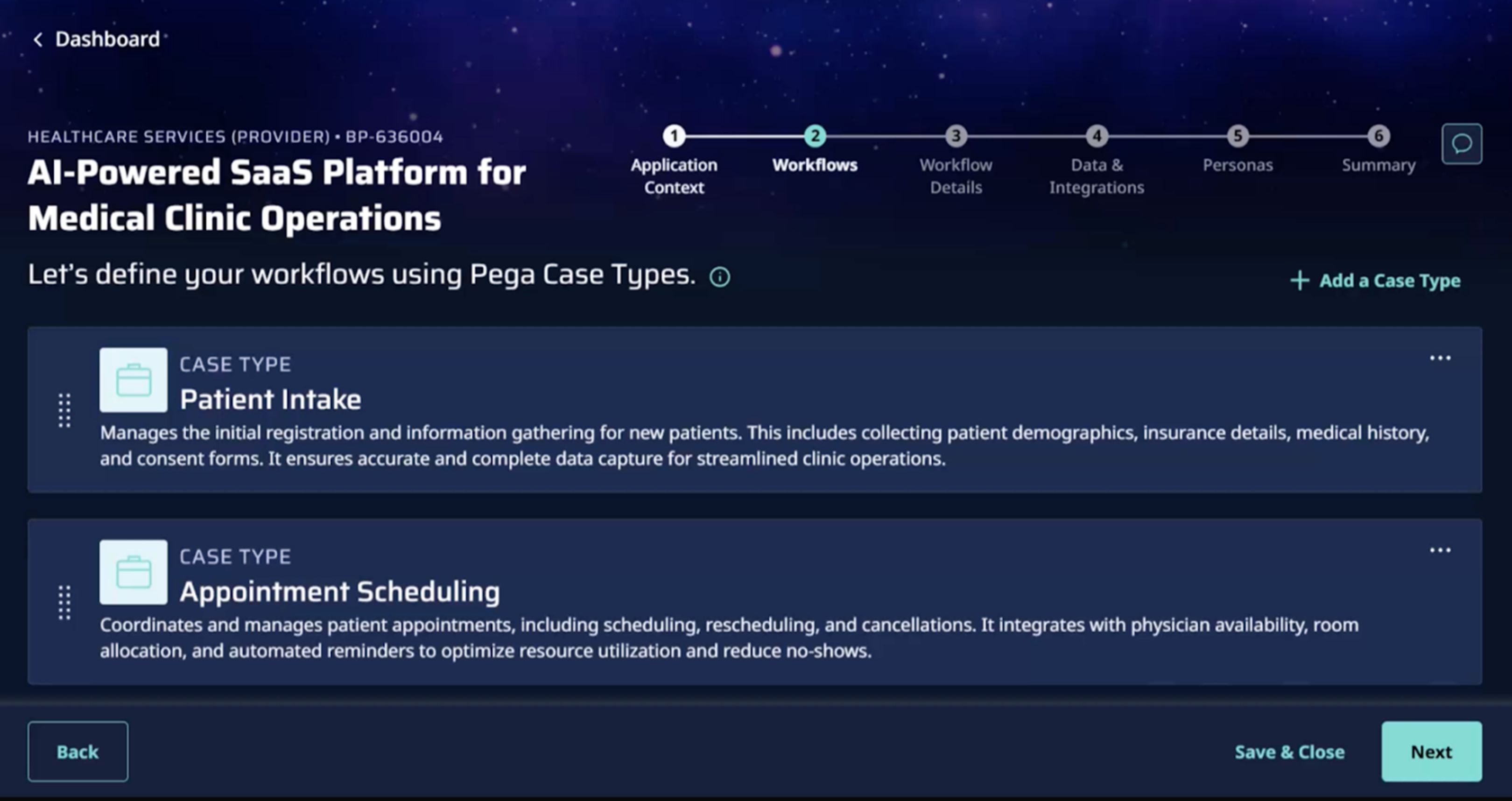
Many AI code builders focus on generating interfaces but provide limited support for business logic. Launchpad includes workflow orchestration based on Pega’s 40-year technology, allowing teams to automate complex B2B workflows across their product and connected systems.
3. No-code development with managed runtime
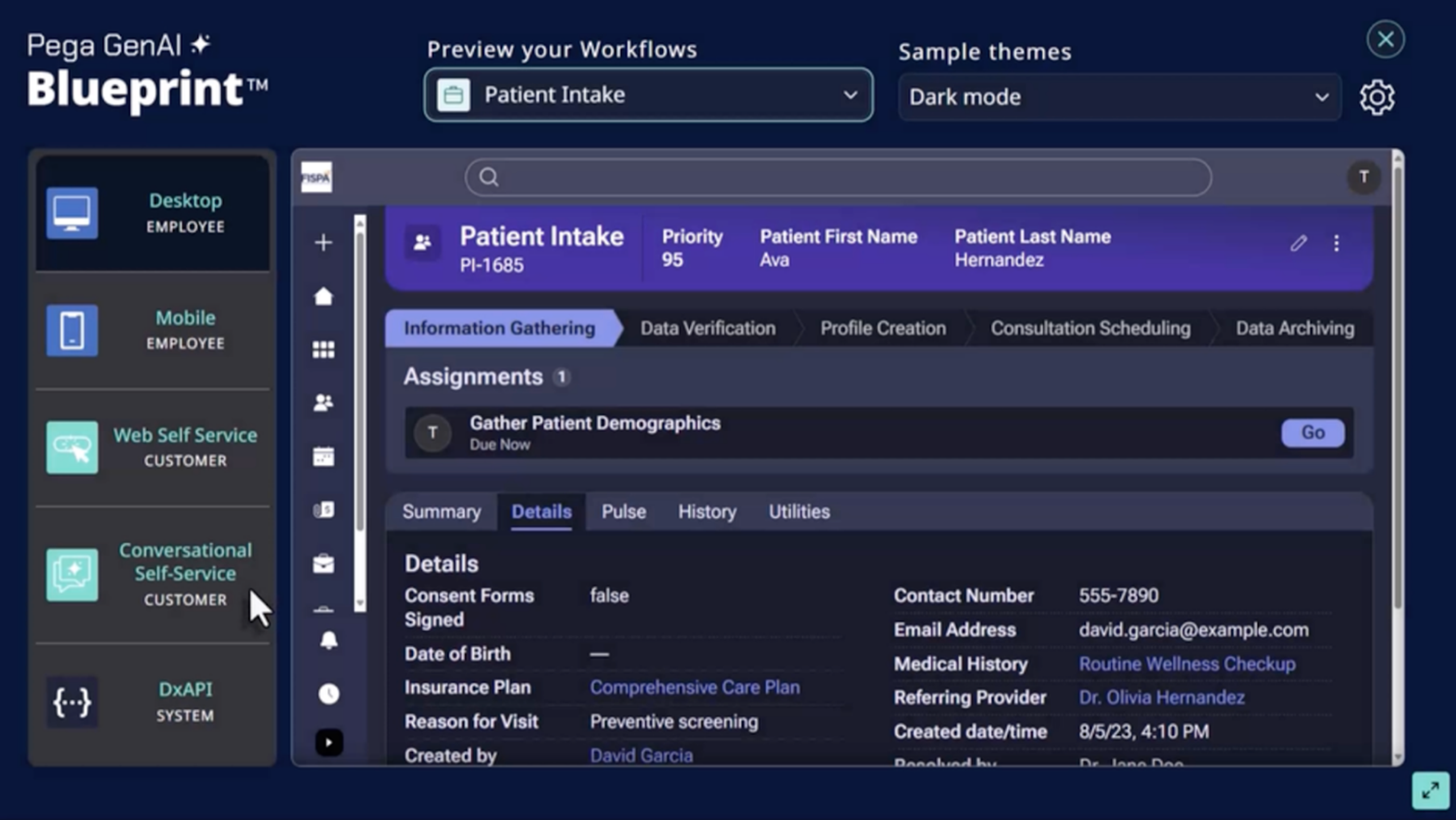
Launchpad’s GenAI Blueprint generates working app blueprints from natural language prompts and provides guidance for workflow automation, UX design, integrations, and reporting.
Unlike tools that produce code files for teams to deploy and manage themselves, Launchpad includes a fully managed runtime on AWS. This reduces the operational overhead required to launch and scale applications.
4. Built for every stage of software modernization
Launchpad supports software teams as they expand product lines and modernize existing infrastructure, without requiring platform switches.
- Build new products: Launch adjacent products faster than traditional full-stack development.
- Enhance existing software: Add agentic AI workflows to current applications without rebuilding from scratch.
- Replace legacy systems: Modernize infrastructure on a single platform to reduce transition risk and technical debt.
5. Reduces reliance on full-stack development
Tech debt accounts for up to 40 percent of IT balance sheets, much of it tied to maintaining foundational platform components rather than building differentiated features. Traditional full-stack development consumes engineering time on work such as authentication, payments, analytics, and admin tooling.
Launchpad includes these components by default, along with built-in cloud infrastructure, databases, security, and scalability. Teams can extend functionality using REST APIs and AWS Lambda when needed, allowing engineers to focus more on product value and less on infrastructure.
6. Usage-based pricing that scales with growth
Launchpad uses a usage-based pricing model similar to AWS, allowing teams to start small and expand as adoption grows. Companies can prototype on a free Explore tier and move to paid plans as their product gains traction. Costs scale with usage, making the model more predictable and aligned with revenue growth.
Choose the right platform for your B2B software development
Replit and Lovable work well for rapid prototyping and bringing AI assistance into the development process.
For software companies building commercial products, production infrastructure and workflow automation need to be in place from day one.
Without these, teams spend months integrating third-party services or rewriting prototypes before they can go live. Launchpad provides production-ready infrastructure and built-in workflow automation, letting teams focus on building and scaling their product.
Start designing for free or book a demo to see how Launchpad helps companies grow to $200K+ annually as customers adopt their software.
About the Author
The Launchpad Team empowers companies to build enterprise-grade, AI-powered software that automates work and delivers measurable outcomes—helping them move from idea to market faster.