

You've identified the use case. You know the problem, you know the market, and you know Launchpad can help you build the application. The next question, the one that separates the software providers who scale from those who stall, is this: do you have a business plan solid enough to move on?
This article is about exactly that. Not theory. Not a framework to validate your idea. A practical set of actions and decisions that will shape how you go to market, how fast you grow, and how much the opportunity is really worth.
Size it quickly: don't let analysis paralysis stop you
You don't need a 40-page market study. You need a defensible back-of-the-envelope that tells you: is this big enough to matter?
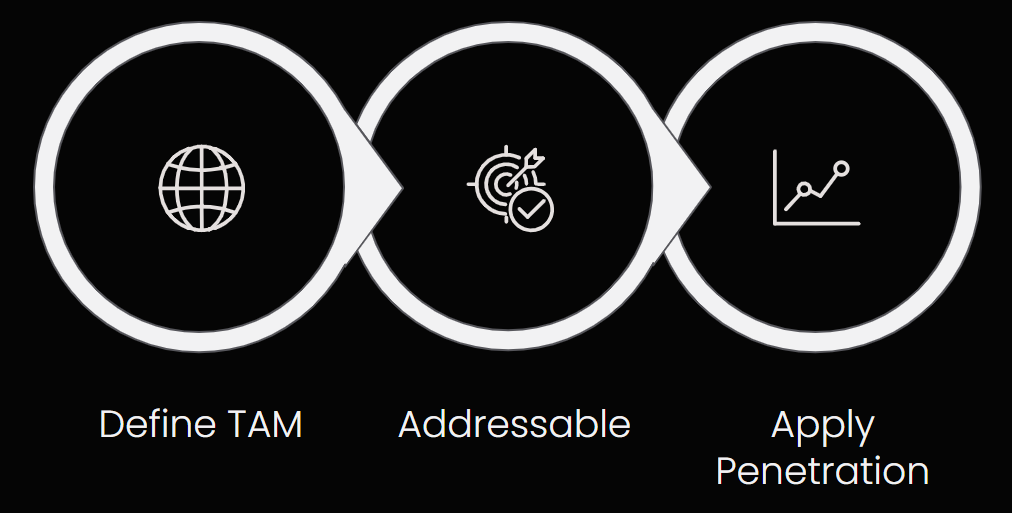
Step 1: Define your TAM (Total Addressable Market)
Start with a count, not a revenue number. Your TAM is the total universe of companies that could theoretically benefit from your application — defined by industry, company size, geography, and regulatory exposure. For a compliance-focused SaaS solution targeting European mid-to-large enterprises subject to NIS2, DORA, and GDPR, a careful count yields roughly 60,000 firms in scope. That's your theoretical ceiling: the number you never actually reach, but the one that anchors everything below it.
Step 2: Narrow to your Addressable Market (three scenarios)
The TAM is the universe. Your addressable market is the realistic slice; where the pain is acute, the budget exists, and the buying trigger is active. Not every firm in your TAM is ready to buy today. Apply a percentage to your TAM to reflect that reality, and build three scenarios to bracket the range:
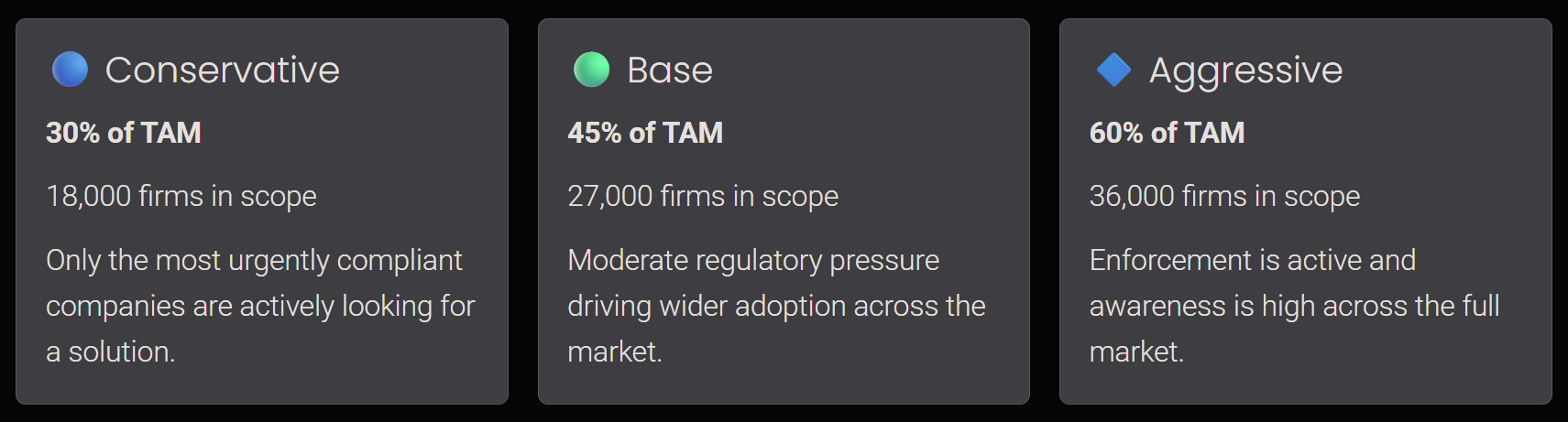
The conservative scenario (30%) reflects a market where only the most urgently compliant companies are actively looking for a solution. The base (45%) assumes moderate regulatory pressure driving wider adoption. The aggressive (60%) scenario reflects a market where enforcement is active and awareness is high.
Step 3 — Apply penetration assumptions and read the revenue range
Once you have your addressable market, apply three penetration rates (one for each level of commercial ambition) to understand what the business could look like at Year 1:
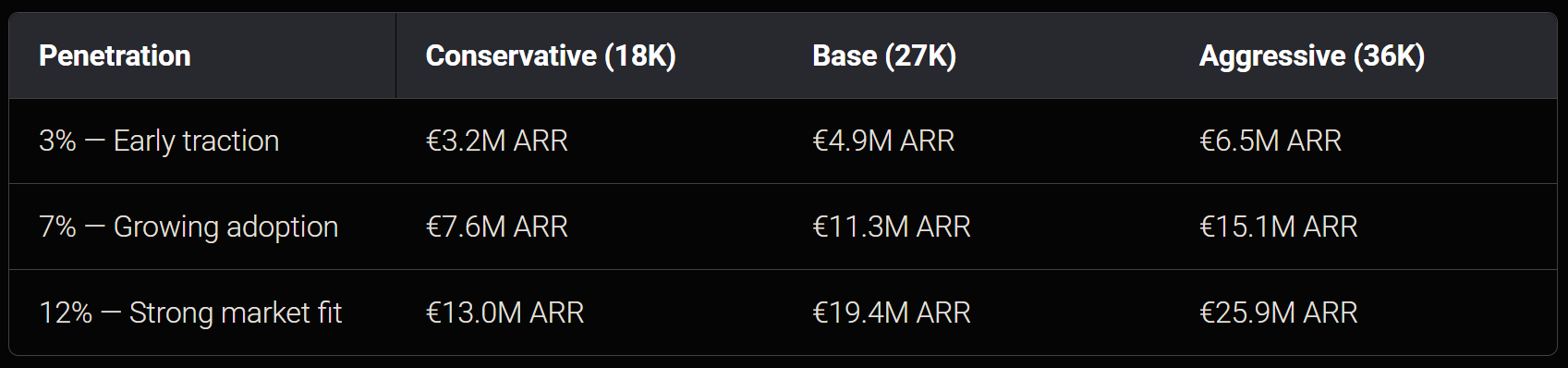
Illustrative example: €6K annual subscription per customer.
The point is not to be precise. It's to know whether you're chasing a €3M opportunity or a €25M one. That changes everything about how you invest.
Build your revenue model — simple, replicable, and stress-tested
Once you've sized the market, turn the numbers into a revenue story. The goal is a model you can defend in a conversation with a partner, an investor, or your own leadership in under five minutes.
Three components matter most:
1. Recurring revenue (ARR)
Customers acquired = addressable market × penetration assumption. Year-1 ARR = customers × annual subscription price. Keep this number honest — early cohorts tend to be smaller and slower than you expect.
2. Services revenue
Most SaaS applications have an onboarding or implementation component, at least in the early stages. Model it separately: services revenue = new customers × average one-off services fee. This is real cash, but it doesn't compound — don't confuse it with ARR.
3. A 3-year ramp (directional)
Plot a plausible penetration curve across three years. Year 1 is about proving the model with early customers. Year 2 is about repeating and refining it. Year 3 is where the compounding starts to show. You don't need precision — you need a narrative that holds together under scrutiny.
A real example: a compliance SaaS targeting European enterprises, at a 3% Year-1 penetration (≈800 customers), a €6K ARR, and an average €3K onboarding fee, generates a combined Year-1 revenue of roughly €7.2M — split between €4.8M recurring and €2.4M services. By Year 3, as recurring revenue compounds and services fees stabilize, the recurring share dominates. That's the story you tell.
Think product-led, not sales-led
Traditional enterprise software is sold through long cycles, big proposals, and complex demos. That model is slow, expensive, and hard to replicate.
The fastest-growing B2B SaaS companies today follow a different playbook: Product-Led Growth (PLG). The product itself becomes the acquisition engine. Customers discover value quickly, expand organically, and convert from free to paid without a salesperson in the room.
What does a PLG approach look like in practice for a Launchpad Provider?
- Create an MVP that delivers value in days, not weeks. Strip the product down to its essential workflow — the one outcome that makes a customer say, "this already saves me time."
- Lower the entry barrier. A freemium tier, a free trial, or a consumption-based model that starts at the cost of a monthly junior hire makes it easy for prospects to say yes without a procurement cycle.
- Let the product do the talking. Reduce onboarding friction. Design the first-use experience to be self-explanatory. Make the "aha moment" happen in the first session.
- Expand from the inside. Once a customer is live, premium add-ons — advanced reporting, automation, integrations, vertical modules — become natural next steps, not a new sale.
The PLG model doesn't eliminate sales. It makes sales more efficient by letting customers arrive already educated, already converted, already convinced.
Go to market faster, accelerated by the AWS BOX Program
Building a great product is only half the journey. Getting to market — fast, with real customers, without burning your runway on infrastructure and demand generation — is where most Providers stall. That's exactly the problem the AWS Business Outcomes Xcelerator (BOX) Program is designed to solve.
BOX is not a standard marketplace listing. It is a structured, milestone-based acceleration program that gives Providers access to couple of things that typically take months and significant budget to secure independently:
1. Funding to cover initial development costs
Through the BOX Fund Request process, eligible Providers can access financial support (including cash and AWS credits) to offset the cost of building and launching their application. This is particularly powerful in the early phases, when development costs are real but customer revenue hasn't started flowing yet. Instead of bootstrapping the build or delaying launch, you submit a feasibility study, and AWS co-invests in getting the solution live.
2. Investment in demand generation campaigns
Once the application is live, BOX provides co-marketing funding and demand generation support. This collapses the time from "live product" to "first paying customer" dramatically, because you're not starting from zero on awareness and distribution.
The practical move for a Launchpad Provider:
- Review the BOX Submission Guide and complete the Feasibility Document to qualify
- Define your MVP scope and submit a fund request to offset development costs
- Plan a joint demand generation activity for the go-live phase
The AWS BOX Program is not just a distribution play. It's a way to de-risk the entire journey from idea to revenue — with a credible infrastructure partner behind you and a funded path to your first customers.
More details: aws.amazon.com/partners/business-outcomes
From idea to deployed application: how Launchpad accelerates every step
Once you've validated your use case, the build phase is where Launchpad changes the game.
The traditional path from idea to live SaaS product takes months of architecture, development, testing, and deployment. With Launchpad, Providers compress that timeline dramatically — moving from workflow design to a deployed, enterprise-grade agentic application in a fraction of the time.
Here's what that journey looks like in practice:
- Idea → Blueprint: Use Launchpad's AI-assisted Blueprint tool to translate your use case into an application structure. No code required at this stage — just your business logic.
- Blueprint → Working Application: Launchpad generates the application scaffolding, case types, workflows, and AI agent orchestration from your blueprint. Your team focuses on differentiated logic, not infrastructure.
- Application → Customer Outcomes: Deploy on a secure, enterprise-grade cloud foundation. Deliver measurable outcomes to your first customers. Use consumption-based pricing to grow with them.
The result: you go to market faster, with less risk, and with a platform that scales as your customer base grows.
The bottom line for Providers
The opportunity in B2B Agentic SaaS is real — and the Providers who capture it won't be the ones with the most sophisticated technology. They'll be the ones who sized the market fast, built a clean revenue model, priced for adoption, and used the right programs (like AWS BOX) to fund the launch and generate early demand.
Launchpad is designed to help you move from business plan to deployed application without the infrastructure overhead that slows most SaaS journeys down.
If you're ready to turn your use case into a go-to-market plan, we're here to help you build it.
Ready to start? Explore Launchpad for free or talk to our team.
About the Author
As Launchpad's GTM Director for EMEA, Luca knows how getting to market fast is critical to software providers; and he is passionate about arming companies with the right plan and the right platform to get them there.