

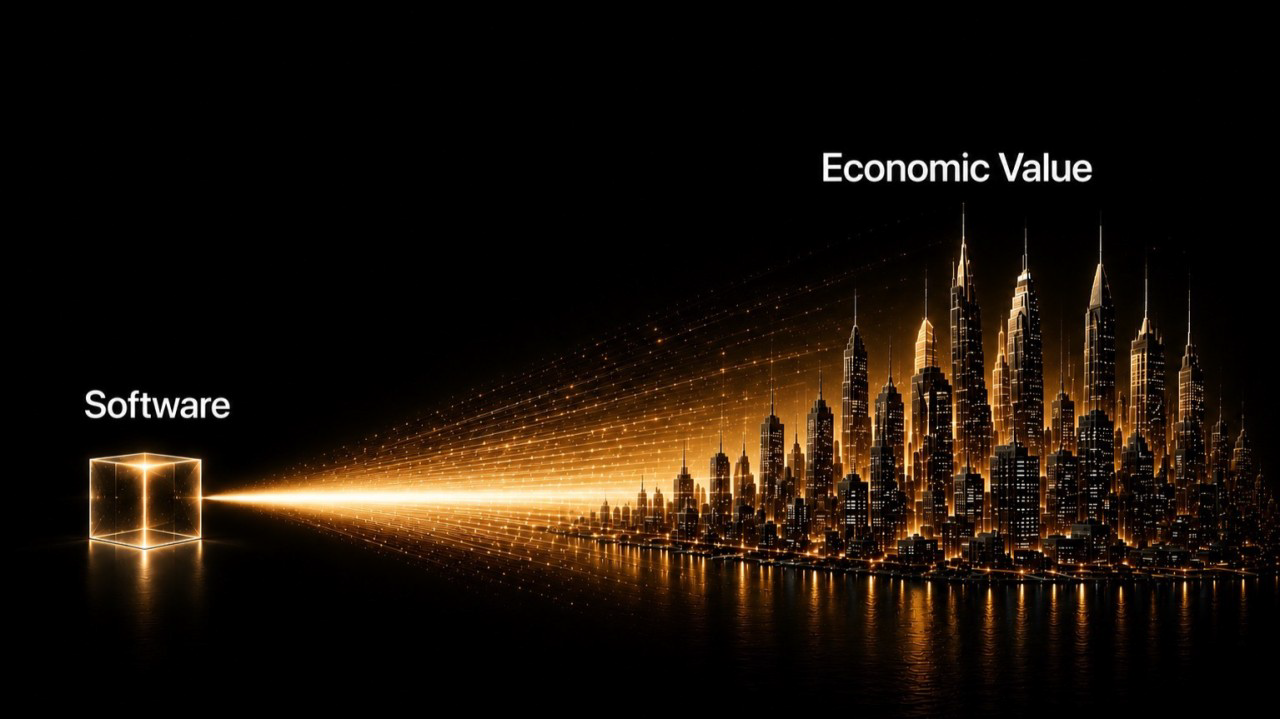
It's rare that a company says or does something that changes more than its own industry. Rarer still is that it changes how investors think about value itself. That may be what SpaceX has done.
When SpaceX recently presented a vision with a $28.5 trillion total addressable market (TAM), many of the subsequent discussions focused on rockets, satellites, and space exploration. Exciting as they were, those were the wrong conversations. The more interesting discussion is this:
What if SpaceX is teaching us how every software company will eventually be valued?
Rockets haven't suddenly become a multi-trillion-dollar industry. Launching satellites is still a relatively modest market. Even global satellite broadband, while enormous, doesn't fully explain trillion-dollar ambitions. The real shift is more profound, and that is that SpaceX has stopped defining itself by what it builds and started defining itself by what it enables.
SpaceX’s vision isn't simply about launching rockets. It's about providing the infrastructure that enables entirely new industries, like global connectivity, AI infrastructure, orbital computing, and eventually even off-world economies.
Whether any or all those opportunities materialize is in fact beside the point. The lesson isn't about space at all. It's that markets are increasingly rewarding companies whose value extends well beyond the products they sell, and the biggest opportunities belong to companies that enable economic activity far greater than the value of their product itself.
Enterprise software is entering the exact same transition.
Software is no longer just selling software
For decades, software companies measured their opportunity by the number of seats (or users or licenses) they could sell. CRM, ERP, ITSM, HR, Accounting, etc… Every category had a relatively well-defined market. Today, artificial intelligence is changing that equation.
Software is no longer just helping people perform work. With AI and agents, software is increasingly automating and orchestrating the work itself. As a result, instead of asking "how many users can we sell to?", investors are beginning to ask: "How much work can this software orchestrate or automate? What outcomes can it deliver?"
When software begins to do the work, not just help people do it, the economics change. The opportunity expands beyond software budgets to include the much larger labor budgets associated with that work.
The addressable market is no longer limited to the value of the software.
It extends to the value of the work itself.
That single shift changes how software is built, commercialized, priced, and ultimately how it's valued.
Consider a claims management software company. Historically, it competed for a portion of an insurer's software budget. But if its platform can automate the processing of claims, it begins competing for a portion of the far larger cost of processing those claims. Its addressable market has expanded from software spend to full operations spend.
Or consider a customer service platform. Instead of competing solely for CRM or customer support software budgets, it can compete for the broader budgets required to resolve customer issues. Again, the opportunity extends beyond the value of the software itself to the value of the work being performed.
For software founders, executives, and investors, this changes the most important strategic question from "What software are we selling?" to "What bigger economic activity are we enabling?". The companies that answer that question well will define the next generation of enterprise software.
The new competitive advantage
AI has fundamentally changed software development, making it possible for anyone with an idea to describe it in natural language and, within minutes, have the foundation of a working application. Whether you call it AI-assisted development, agentic development, or "vibe coding," the barriers to creating software have fallen dramatically.
Last weekend, I used Launchpad's AI Assistant to build an agentic application that helps airlines automate the handling of flight cancellations with an improved customer experience. As a former non-technical founder, what struck me wasn't how quickly I could build the application. It was how easily it could become something capable of operating as a real software business.
My experience reinforced something important: building an application has never been the hardest part of building a successful software company. Running one is. Ironically, that makes enterprise-grade software infrastructure more valuable, not less.
An impressive demo isn't the same as an enterprise-ready product. Enterprise customers expect security, governance, scalability, reliability, compliance, commercial readiness, and operational excellence from day one.
This is the challenge that every modern software company is now embracing. This is also why enterprises will continue to buy software rather than building and maintaining it themselves, and why we can stop talking about the SaaS-pocolypse as anything other than a change in economic models.
AI has made building applications dramatically easier. It has not made building software companies easier. Looking forward, successful software companies won't simply create AI-powered applications faster than everyone else. They'll rapidly transform those applications into secure, scalable, commercial products that deliver outcomes which their enterprise clients can trust.
That’s why we built Launchpad. The platform combines AI-powered, low-code development with production-ready, enterprise-grade architecture, enabling software companies to move from ideas to workflows to agentic applications to enterprise-ready outcome-based businesses easier than ever before.
From applications to outcomes
AI and agents are driving a generational shift. Whereas customers historically purchased software to help people complete work. Now, they will increasingly purchase software that completes the work for them, delivering outcomes like processed claims, completed audits, approved loans, resolved inquiries, and generated revenue.
Of course, not every outcome needs to be fully autonomous. Businesses rely on human-centric judgement, approvals, exception handling, and governance. And not every activity needs to be agentic. Workflows and deterministic logic deliver predictability, control, and trust. Use AI in design time and when reasoning adds value, use deterministic workflows where repeatability matters.
In this future, the product is no longer just software. The product becomes the outcome. Software is becoming the factory. Outcomes are becoming the product. Once software performs the work, customers stop buying technology and start buying results.
This is the big change and the lesson to be taken from SpaceX. Tomorrow's software companies won't create the most value simply by delivering software. They'll create value by enabling their customers to achieve outcomes that are worth far more than the software itself. That's why the industry will move from SaaS to Outcomes-as-a-Service.
Infrastructure becomes the value
The SpaceX story wasn’t really about rockets. It was a vision about providing infrastructure that enables new industries. And it planted a question that every software company should now ask itself: What business are we really in?
Are you selling software? Or are you enabling your customers to capture more value than your software alone represents? That distinction will increasingly determine how markets value software companies over the coming decade. The ones that will win in this next era will have several things in common, including:
- They'll move from idea to production in days instead of months.
- They'll commercialize from day one.
- They'll deploy globally without having to build commodity infrastructure themselves.
- They'll monetize outcomes and work performed—not simply seats.
- They'll continuously evolve through AI.
- They'll build on platforms that let them focus on growth instead of code or infrastructure.
The next software economy
Every major technology transition creates a new layer of infrastructure:
- The internet created cloud platforms.
- Cloud platforms created SaaS.
- AI will create outcome platforms.
- Outcome platforms will empower companies to deliver outcomes-as-a-service.
Those next great software companies won't be defined by the elegance of their code, a DIY stack, or even the intelligence of their AI. They'll be defined by how effectively they help customers achieve outcomes. They'll build, commercialize, and scale faster, and they'll monetize the work their software performs, not just the people who log in.
That's the shift investors are beginning to recognize, and it is the shift every software company should be preparing for.
The addressable market is no longer limited to the value of the software. It extends to the value of the work itself.
Software is becoming the factory.
Outcomes are becoming the product.
The companies that understand these shifts won't just participate in the next decade of enterprise software.
They'll define it.
About the Author
John Huehn serves as Chief of Launchpad, where he is passionate about helping software companies build, commercialize, and scale AI-powered businesses that deliver measurable outcomes. He believes the next generation of software leaders will be defined by the outcomes they deliver, not the applications they build.