

Quick summary
Rebuilding foundational infrastructure can be a major contributor to longer software development timelines. Authentication, provisioning, billing, and deployment pipelines can consume significant engineering time without building any competitive advantage. Teams that shift from full-stack development to platform-based orchestration ship faster and scale without additional overhead.
Why software products take longer to ship than they should
Most software product delays are not caused by poor planning or slow engineers. They are caused by how software is built and how much time goes into infrastructure that customers never see.
Authentication, tenant provisioning, billing systems, deployment pipelines, integrations, and workflow automation are required for almost every SaaS product. Yet none of them differentiate the product. Teams can spend months building these foundations before they start working on the features customers actually pay for.
For B2B software companies, that delay has a real cost. Longer release cycles slow revenue growth, delay customer feedback, and make it harder to compete with companies shipping new capabilities faster. This article explores the factors that slow SaaS delivery and how software companies are reducing time-to-market without sacrificing scalability.
Why listen to us?
At Launchpad, our platform is powered by Pegasystems, a leader in enterprise workflow automation. With over 40 years of experience, Pega has delivered solutions to Fortune 500 companies across finance, healthcare, and global operations.
We didn’t concern ourselves with full stack engineering from the beginning...We brought in Pega and AWS early, so our small team could focus on outcomes, not infrastructure.
-Joseph McLean, Co-founder & CEO, Quavo
This guide draws on Pega's decades of enterprise software experience and Launchpad's work with B2B software companies. Companies such as Quavo demonstrate the potential of the underlying platform approach: Quavo built its SaaS business on Pega Infinity, which shares core capabilities with Launchpad, and grew to more than $50 million in ARR before securing a $300 million investment from Spectrum Equity.
What actually slows software product releases
The most common explanation for slow software releases is team bandwidth or roadmap bloat. But the deeper issue is structural. Most B2B software products require the same set of foundational systems regardless of what the product actually does. Though building those systems from scratch consumes a disproportionate share of every development cycle.
These are the bottlenecks that consistently push release timelines out:
Infrastructure setup: Before a single feature ships, teams need cloud environments configured, databases provisioned, and deployment pipelines in place. For companies building on full-stack architecture, this alone can take weeks.
Authentication and identity management: User roles, permissions, SSO, and tenant-level access control are non-negotiable for enterprise SaaS products. They're also time-consuming to build correctly and a frequent source of security issues when rushed.
Billing and subscription management: Usage tracking, invoicing, plan management, and payment processing have to be built and maintained. Most teams underestimate how much ongoing engineering time this area requires after the initial build.
Multi-tenant architecture: Serving multiple customers from a single application while keeping their data isolated is one of the more complex engineering challenges in SaaS. Teams that build this manually often discover gaps only after they've signed their first enterprise customer.
Fragmented tooling: When development, workflow automation, integrations, and deployment span multiple tools, coordination overhead compounds. Context switching slows individual engineers. Handoffs between systems introduce delays and bugs.
Deployment complexity: Managing staging environments, release versioning, rollback procedures, and production monitoring requires dedicated attention. For teams without a platform to handle this, it pulls engineers away from product work.
Each of these challenges is manageable individually. Together, they consume a significant portion of every development cycle. The result is that engineering effort is spent on infrastructure that every competitor needs as well, rather than on the capabilities that drive differentiation.
Why MVP speed often creates long-term friction
Shipping an MVP quickly generates early customer feedback, validates the core use case, and starts the revenue clock before the full product is built. But speed at this stage means deferring decisions that will prove expensive later, particularly regarding architecture, security, and scalability.
When those foundations are skipped in favor of a faster initial release, the gaps tend to surface at the worst possible time. The following scenarios show how MVP shortcuts create the friction that slows every subsequent release:
A product built on single-tenant architecture reaches its first enterprise customer, who requires strict data isolation. The team pauses development of new features to re-architect the backend.
A basic authentication setup works fine for early users, but becomes a blocker when a mid-market buyer requires SSO and granular role-based permissions.
A manually managed billing process holds up during beta but breaks down as plan complexity increases and usage-based pricing becomes a customer expectation.
A deployment process that worked for a small user base will require significant rework to meet enterprise-level reliability and uptime requirements.
In each case, the team ends up doing two builds. The one that got the product to market, and the one that makes it enterprise-ready. That second build occurs precisely when engineering effort should be directed toward product iteration rather than infrastructure repair.
The shift from coding features to orchestrating systems
For years, software development was largely focused on building features. Product roadmaps revolved around creating new functionality, writing application logic, and expanding the product's capabilities.
That model is changing. Modern SaaS products depend on an ecosystem of workflows, integrations, automations, AI services, and business processes that must work together.
Delivery speed is no longer determined solely by how quickly teams can write code. It increasingly depends on how efficiently they can connect and coordinate systems. A team that orchestrates well ships faster than a team that simply codes more. The teams reducing time to market fastest are making this shift across four areas:
Workflow automation over hardcoded logic
When business logic is hardcoded into the application layer, every change requires an engineer. When it's model-driven, defined through rules and conditions rather than custom code, the same logic can be modified, reused, and extended without touching the codebase. This compresses the time between a product decision and a shipped change significantly.
Integrations as reusable components
Building a custom integration for every external system a product touches is one of the more expensive ongoing costs in SaaS development. Teams shifting to orchestration treat integrations as reusable components. For example, a connector to a payment platform or a CRM doesn't need to be rebuilt every time a new product launches.
AI that performs work, not just assists it
The more meaningful productivity shift comes from embedding AI directly into workflows rather than bolting it onto the product as a standalone feature.
When AI can route decisions, trigger approvals, process documents, and execute actions within a workflow, it delivers outcomes. For B2B software companies, that distinction matters as customers are increasingly paying for results, not features.
Reusable app logic across products
Every SaaS product a company ships tends to share common logic of user management, notification systems, reporting structures, and access controls. Reusable app logic means that common components built once become building blocks for every subsequent product, compressing development timelines with each new release.
How low-code platforms accelerate software delivery
The traditional development model requires teams to make a series of build-or-buy decisions before a product can ship. Most end up building, and that decision alone adds months to every release cycle.
Low-code platforms change the default. Instead of assembling a stack from scratch, teams work from a platform that already handles the infrastructure, runtime, and operational layer.
That change in starting position is what drives faster software delivery. Here is how it plays out across the development lifecycle:
Visual workflow building
Traditional development requires an engineer to translate every change in business logic into code, test it, and push it through a deployment cycle.
For products that are workflow-heavy by nature, such as approval processes, multi-step automations, and conditional routing, development demands can grow quickly. This often creates a bottleneck between what the product needs to do and what the team can build.
Visual workflow builders close that gap. Business logic is defined, modified, and extended through a visual interface. This means iteration happens faster and the product can evolve in response to customer feedback without queuing every change behind an engineering sprint.
Reusable components across products
Every time a software company launches a new product, a significant portion of the development work repeats work already done in the last one. Data models are rebuilt, UI components are redesigned, and integration connectors are reconfigured. Low-code platforms that support reusable components break this pattern.
Logic and components built for one product become building blocks for the next. Over time, each new product takes less time to build than the previous one because the team is extending an existing foundation rather than starting from scratch.
Faster customer provisioning
For B2B software companies, the time between signing an enterprise customer and delivering a working product is a critical window.
Manual provisioning processes (configuring tenant environments, setting up access controls, and migrating data) extend that window and consume engineering time that should be going toward product development.
When provisioning is automated at the platform level, new customers are onboarded faster, and the team's attention stays on the roadmap rather than individual customer setups.
Embedded AI and automation
Adding AI to a software product after the fact is an expensive and time-consuming process. Connecting models, defining how AI outputs feed into product workflows, and ensuring outputs meet business rules requires significant engineering effort.
Platforms that embed AI directly into the workflow layer change this. Teams can incorporate intelligent decision-making, automated document processing, and AI-driven routing into the product from the start.
Simplified integration management
Enterprise customers rarely use software in isolation. They expect the products they buy to integrate with their existing systems, such as CRMs, ERPs, data warehouses, and communication platforms.
Building and maintaining those integrations manually is an ongoing engineering cost that grows with every new customer requirement. Low-code platforms with prebuilt connectors and API management tools reduce initial integration build time. They also make it significantly easier to add new connections as the customer base expands.
Why multi-tenant architecture changes delivery speed
Multi-tenant architecture affects delivery speed in three areas that become increasingly important as a SaaS product grows. They are deployments, provisioning, and tenant management. Here’s a short comparison of the multi-tenant and single-tenant approaches to understand their effect on these three areas:
Area | Single-Tenant Approach | Multi-Tenant Approach |
Deployments | Separate environments and updates for each customer | One shared application with centralized updates |
Provisioning | Customer onboarding often requires manual setup and configuration | New tenants can be created through standardized processes |
Tenant Management | Access controls, configurations, and reporting are managed separately | Centralized administration across the customer base |
The biggest advantage comes from reusable deployments. Instead of coordinating updates across multiple customer environments, teams maintain a single application and deploy changes once. This reduces operational complexity and makes releases easier to manage as the customer base expands.
Provisioning also becomes more predictable. New customers can be onboarded through repeatable processes rather than treated as individual implementation projects. That shortens the time to value while reducing the engineering effort required to support growth.
Tenant management follows the same pattern. Access controls, configuration settings, usage reporting, and customer administration can be managed centrally rather than recreated for each deployment. As more customers are added, operational effort grows much more slowly.
These benefits are difficult to achieve when teams build and maintain multi-tenant infrastructure themselves. Platforms that provide multi-tenant architecture as part of the foundation remove much of that complexity from the delivery process.
How Launchpad helps teams ship faster
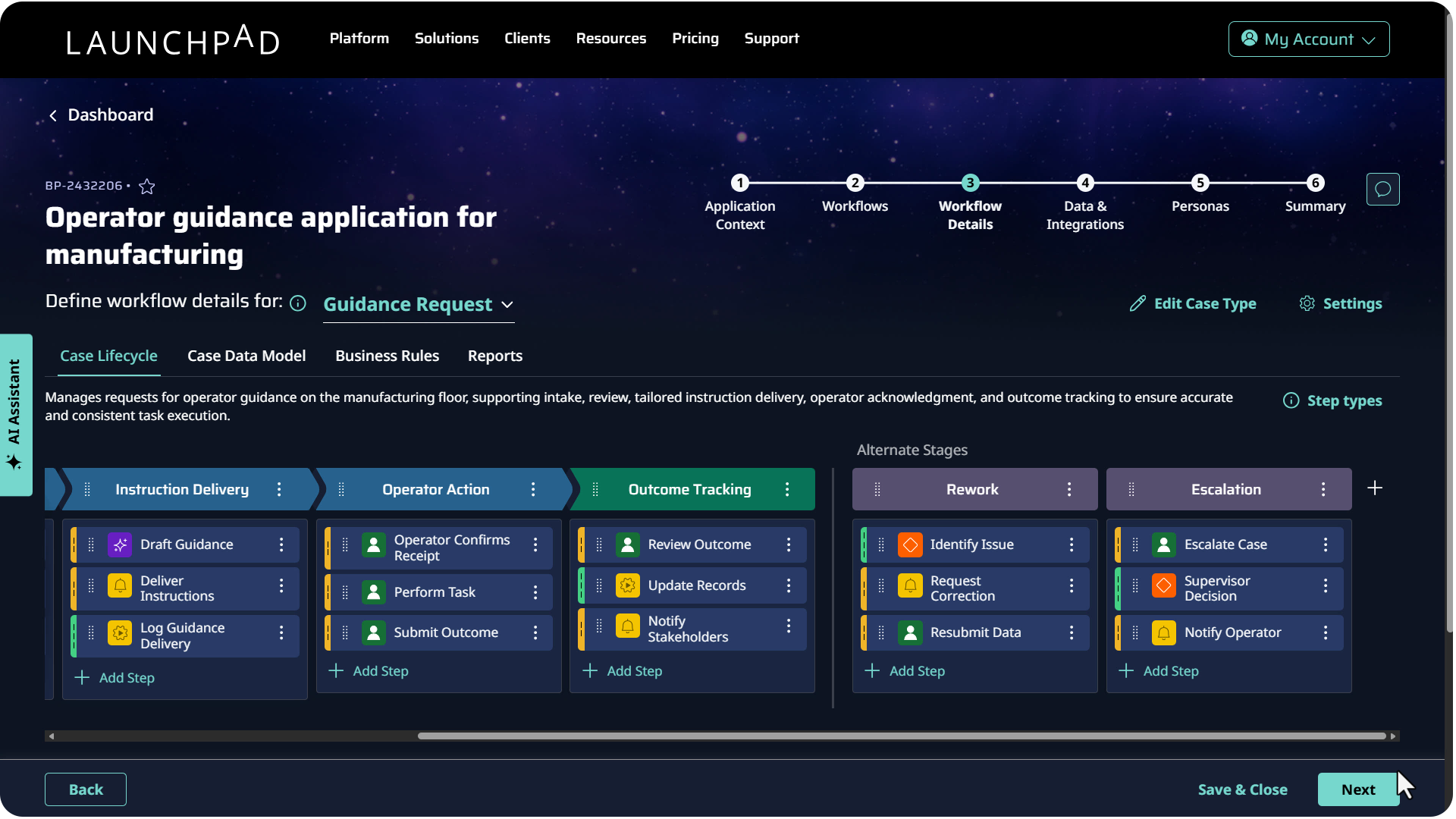
Launchpad is an AI-assisted platform built specifically for B2B software companies building products to sell. Backed by Pegasystems' 40+ years of enterprise software experience, it combines AI-assisted, low-code development with managed enterprise architecture, workflow orchestration, multi-tenancy and subscriber management.
Fielo CEO Sanjay Agarwal says Launchpad cut the company's development cycles by 50% or more, with some work that previously required two or three sprints completed in half a sprint.
Here is how Launchpad's core capabilities directly reduce time to market across the product development lifecycle:
GenAI Blueprint: Describe the product, and Launchpad automatically generates a structured application design (including case types, data models, workflows, personas, and UX screens). Teams start with a structured application design rather than a blank slate, compressing the time from an idea to a testable product from months to days.
Workflow automation and orchestration: Business logic is defined through a model-driven interface rather than custom code. Long-running workflows, conditional automations, status-driven processes, and multi-step approvals are configured visually. When requirements change, workflows are updated without touching the underlying codebase
Built-in enterprise infrastructure: Cloud hosting, database management, multi-tenant architecture, security, and identity management are all handled by the platform. DevOps and CloudOps never appear on the product roadmap because Launchpad owns them entirely.
Automated provisioning and subscriber management: New customers are onboarded automatically, and tenant provisioning, access configuration, and identity management are handled at the platform level. The subscriber management portal gives teams full visibility into usage and administration across their entire customer base, without having to build that tooling themselves.
Versioning and controlled releases: New product versions are developed and tested without disrupting existing customers. Updates roll out in a controlled sequence, reducing release risk and giving enterprise customers the stability they expect from production software.
Agentic AI embedded in workflows: AI is embedded directly into workflow steps rather than added as a standalone feature. It evaluates documents, routes work, triggers approvals, generates recommendations, and executes actions.
These capabilities work together as a single platform, so teams do not need to integrate separate tools for infrastructure, workflow automation, AI, and subscriber management. Everything needed to build, deploy, and scale a commercial SaaS product is available from day one.
Software development options compared
Choosing the right development approach directly impacts how quickly a product reaches the market and how well it holds up once it gets there.
The table below compares three options B2B software companies typically consider. They are custom full-stack development, pure no-code tools, and Launchpad:
Area | Custom development | General-purpose no/low-code | Launchpad |
Application logic | Team builds | Platform-assisted | Platform-assisted |
Infrastructure | Team selects / manages | Varies by platform | Managed |
Multi-tenancy | Team builds / selects | Varies | Built in |
Subscriber management | Team builds / selects | Varies | Built in |
Workflow | Team builds / selects | Varies | Built in |
Integrations | Team builds / selects | Connectors / APIs vary | APIs, connectors and custom components |
Cloud operations | Team responsibility | Varies | Managed |
Target use case | Any software | Varies | Commercial B2B workflow applications |
The right choice depends on the type of product being built and the level of scalability required. Traditional no-code platforms work well for internal applications, while custom development remains an option for highly specialized systems.
For software companies building products to sell, Launchpad combines fast delivery with the infrastructure and scalability required for long-term growth.
Faster product releases create a compounding advantage
Most discussions about “time to market” focus on the first launch. The bigger opportunity is what happens afterward.
Every SaaS product release creates assets such as workflows, integrations, provisioning processes, AI automations, and application logic. Those assets create value only when they can be carried forward, not rebuilt from scratch on the next product.
That is why reducing time-to-market is not simply a development challenge. It is a systems challenge. The companies shipping fastest spend the least time recreating infrastructure and the most time extending what already works.
Launchpad is designed around that idea. Instead of treating every product as a new project, this approach gives software companies a foundation they can continue to build on as their products, customers, and requirements evolve.
Start building on Launchpad's free Explore plan and see how much faster your next product ships.
Frequently Asked Questions
What is the time to market in SaaS development?
Time to market refers to the total time it takes to go from a product idea to a live, customer-facing release. In SaaS development, this includes architecture decisions, infrastructure setup, feature development, testing, and deployment.
For B2B software companies, it also includes the time spent building foundational systems like authentication, multi-tenancy, and billing. This often consumes a larger share of the development cycle than the product features themselves.
What causes SaaS products to miss their release timelines?
The most common cause is underestimating the time required for infrastructure that isn't visible to customers. Authentication, tenant provisioning, deployment pipelines, and integration management are required for almost every B2B SaaS product but rarely appear on product roadmaps with realistic time estimates. Technical debt from earlier shortcuts and fragmented tooling also compounds over time, slowing every subsequent release.
Is a fast MVP always the right approach for B2B SaaS?
Shipping an MVP quickly makes sense for validating a use case and generating early customer feedback. The risk is building on a foundation that can't support enterprise requirements, data isolation, SSO, role-based access, and scalability.
When those gaps emerge after the product already has customers, teams often find themselves rebuilding parts of the solution. This happens at the exact time when engineering resources should be focused on product improvements and iteration.
About the Author
Kat Austin works in product marketing for Launchpad and helps companies of all sizes understand how to use SaaS to innovate and grow revenue faster than ever before.