

Note: This article focuses primarily on software intended for the U.S. healthcare and life sciences market. Requirements vary by application, customer, state, country, and the types of data processed.
Quick summary
Low code in healthcare can help product and IT teams ship HIPAA-ready applications faster through visual configuration. This guide covers where it fits, the workflows it must automate, high-impact use cases, and a checklist for choosing a platform that meets healthcare's security and regulatory criteria.
Why healthcare software is so hard to build
Healthcare software has to move fast right now. Doctors need patient data on the spot. Regulators want every action tracked while insurers need clean, structured claims. And patients expect apps that feel as easy as the ones they use every day outside of healthcare.
But speed isn't the only pressure. Healthcare has been the most expensive industry for data breaches. In 2025, the average cost of a healthcare data breach in the United States was $7.42 million, down $2.35 million year over year. Healthcare nevertheless remained the costliest industry for breaches for the 14th consecutive year.
Teams need to move fast, but they can't skip the important part. This Launchpad guide covers where low-code fits in healthcare and how to evaluate a platform’s security, interoperability, and workflow capabilities. Learn how Launchpad helps software companies build AI-powered healthcare and life sciences applications.
Design your healthcare & life sciences software on Launchpad.
Why Launchpad’s perspective matters
Launchpad is built on Pega’s enterprise workflow and case-management foundation. It helps B2B software companies build commercial, workflow-centric applications with capabilities such as multi-tenancy, subscriber management, governance, security controls, and auditability. Those capabilities are particularly relevant to software providers selling into regulated markets, including healthcare and life sciences.
Launchpad was a huge part of our journey and a huge accelerator. We have been able to build a successful company and deliver a high-value solution without tons of money and resources.
Kimberly Tableman
CEO, Espero Health
Where legacy development approaches are failing the healthcare industry
Large EHR environments can involve complex upgrade, testing, governance, and integration cycles. As a result, new patient-facing experiences may take significant time to prioritize and deploy when they depend on changes to the core EHR.
So, any new patient-facing feature waits in line on a vendor's roadmap instead of shipping when the market needs it.
Older revenue-cycle platforms may require additional integrations or middleware to support newer payment experiences and connect them with existing billing workflows. Organizations can also struggle to find and retain specialists who understand legacy HL7 interfaces, custom integrations, and the operational context around them.
Then there's the extra work of manually coding compliance. Every new feature must comply with HIPAA privacy and security requirements, integrate with hospital login systems, and maintain complete audit logs of all user actions. Some features may also need to comply with FDA 21 CFR Part 11 regulations.
Building these controls from scratch for each app slows things down, turning months into years. And every custom fix adds more ways things can go wrong.
Most healthcare CTOs know this problem. The majority of the budget goes to keeping old systems running, while the backlog of new ideas keeps growing. Patient portals stay half-built, telehealth doesn't sync with scheduling, and many practices still coordinate referrals by fax and phone.
Why product teams are turning to low-code
The economics have shifted. What used to require a full-stack engineering team plus a compliance analyst can now be assembled by a smaller group using visual configuration.
Patient intake forms, referral workflows, and incident reporting apps come together in days rather than quarters. The people who know the domain best are the ones actually shaping the tools.
Gartner projected the low-code market would reach $58.2 billion by 2029. Healthcare has been slower to adopt this than finance or manufacturing. But that's changing fast, pushed by four key pressures:
- Faster clinical changes: New care steps, safety checklists, and reports can go live in a single sprint, not months.
- Non-developers can build too: Nurses, informatics staff, and operations managers can set up apps themselves, without waiting on IT for every small change.
- No need to replace the EHR: New tools for patients and staff can connect to Epic, Oracle Health, or MEDITECH through APIs. So, no rip-and-replace needed.
- Smarter use of talent: Skilled developers focus on the hard integration work, while everyone else handles the simpler setup.
Low-code fits best wherever clinical or operational work is a chain of decisions. That's exactly what workflow-first low-code platforms are built for. Not every platform can actually do this well, but the ones that can are changing how care teams build software.
Common healthcare applications you can build using low-code
Results show up wherever forms, workflows, and rules drive the work. Here are the areas where healthcare teams are already seeing real results today:
Patient intake and digital front door
Most health systems still run registration, insurance checks, consent forms, and pre-visit questions on paper or PDFs. Low-code lets teams build simple web and mobile forms that send data straight into the EHR, cut down admin work, and let patients fill things out at home.
Care coordination and clinical workflows
Care often breaks down between primary care, specialists, discharge planners, and community services. Low-code apps turn these into clear workflows with owners, timers, and automatic alerts. Teams can see who's responsible at each step, and gaps show up on a dashboard.
Safety, incident reporting, and regulatory compliance
Adverse events, near-misses, and safety issues need to be reported fast and sent to the right person. Paper or email reporting slows this down and hides real numbers. Low-code lets safety officers build simple reporting forms, checklists, and dashboards that catch trends early and support applicable accreditation, patient-safety, workplace-safety, CMS, and state reporting requirements.
Customer service and patient support platforms
Contact centers handle appointment questions, billing issues, prescriptions, and prior authorization checks. They need one clear view of the patient to solve problems fast. Low-code lets service leaders build agent tools that pull data from EHR, billing, and pharmacy systems, automatically route issues, and track SLAs.
Drug development and clinical trial applications
Sponsors and CROs use low-code to build investigator portals, adverse event tracking, protocol deviation logs, and site monitoring dashboards. These are regulated environments, so they require FDA 21 CFR Part 11 controls for e-records and signatures.
Supply chain and manufacturing operations
Hospital supply chain, pharmacy inventory, and med-device manufacturing operations all rely on visibility across suppliers, warehouses, and clinical use. Low-code lets operations leaders build asset-tracking, expiration-monitoring, and procurement-approval workflows that pull data from ERP systems and connect to clinical demand signals.
Remote patient monitoring and connected wearables
Wearables, BP cuffs, glucose monitors, and home devices feed vitals into clinical workflows. When a reading falls outside a safe range, care teams can reach out, adjust medication, schedule a visit, or escalate care. Low-code handles consent tracking, HIPAA workflows, and device-to-EHR syncing as built-in features.
Telehealth and virtual care platforms
Virtual visit scheduling, e-consent, video sessions, e-prescribing, and post-visit notes are all workflow-heavy, exactly what low-code handles best. Teams can adjust visit types, add specialties, and connect to EHR order entry without a full code release.
Prior authorization and utilization management
Prior auth, medical-necessity docs, appeals, and payer tracking are multi-step workflows that break down when handled on paper and in spreadsheets. Low-code lets teams set payer-specific rules, track SLA deadlines, and route escalations. It cuts approval times and avoids missed-window write-offs.
Revenue cycle and claims workflows
Charge capture, coding checks, claims edits, denial management, and appeals all require workflows aligned with payer rules, specialty-specific logic, and state requirements. Low-code lets revenue teams update these rules as payer contracts change, without waiting on IT. Denials are handled in days instead of weeks, meaning faster cash flow.
Key workflow automation capabilities your low-code-built healthcare application must have
Choosing low-code is the easy part. Making the app hold up in a real, regulated clinical setting is where most projects run into trouble. A few key workflow features separate real production platforms from others:
Multi-step routing with clinical escalation
Care handoffs, incident reviews, and prior auth all need to be routed based on severity, care setting, coverage type, and time of day. With automatic escalation the moment an SLA is missed. Simple approval chains look fine in a slide deck, but fall apart in the first real week of use.
Document intake and AI-assisted triage
Intake forms, past records, imaging reports, referral letters, and authorization letters all feed into the same workflows. A solid platform pulls out the key data, sorts each document, and routes it automatically. So, no one has to open every file by hand. AI should be built right into this process, not as a separate tool.
Rule-based clinical and business logic
Eligibility, coverage, dosing, escalation triggers, and reporting thresholds are all rules. Informatics teams need to create and update these rules on their own, without waiting on a code release. And every rule needs a clear record. Regulators and safety committees will want to know exactly which rule triggered which decision.
Full audit trails and immutable logging
Healthcare workflows may be subject to internal review, security investigation, quality oversight, contractual review, or regulatory audit. That means user actions, rule executions, AI outputs, and routing decisions all need timestamps, actor identities, and before/after states captured as they happen. Retrofitting audit logging into a live application is expensive, and worse, it tends to leave gaps auditors will find. Use tamper-resistant or appropriately protected audit logs that capture relevant user actions, rule executions, AI-assisted outputs, and routing decisions.
Multi-tenant data isolation for health systems and networks
Health systems with multiple hospitals, MSOs supporting several practices, and payer platforms serving several plans all require strict tenant separation. This is what multi-tenant SaaS architecture is designed to solve, with the added healthcare requirement that isolation must be defensible under HIPAA and state privacy laws.
Real-time dashboards for operations and quality
Charge nurses need to know, right now, who's past their discharge SLA. Quality teams want to see incident trends by unit, and revenue cycle needs denials broken down by payer. A nightly report simply doesn’t work. Dashboards need live data, so teams can act in the same shift, not the next day.
Benefits of low-code healthcare development
Here's what healthcare teams most often see once these platforms are in production:
Faster time to deployment
The speed gain can be significant. Fielo reduced development timelines by more than 50% after moving its loyalty-management product to Launchpad.
Lower total cost
Costs drop in three places at once. Less custom development, less maintenance, and one predictable platform bill instead of separate hosting and security costs. For health systems already stretched thin on IT budgets, that's where the real savings show up.
Less reliance on scarce developers
Healthcare already struggles to find engineering talent. Healthcare organizations also face infrastructure and skills constraints. In a 2025 HIMSS Market Insights survey, two-thirds of healthcare leaders cited infrastructure limitations as a barrier to achieving care-delivery goals. Low-code doesn't remove developers. But it frees them up for harder work like EHR integration, often boosted by AI coding tools. Meanwhile, informatics and operations teams can build simpler tools themselves.
Faster regulatory updates
Rules from CMS, states, and the FDA change often. Teams that need a full code release every time fall behind. With low code, compliance teams can update rules and forms directly, closing that gap fast.
Better teamwork across teams
Low-code closes the usual gap between clinicians, compliance, and engineering. Teams can draw workflows together, so nothing gets lost in translation, and changes happen faster.
Easier legacy integration
No one wants to rip out their EHR. Low-code lets teams build new, modern experiences on top of it through secure APIs. It keeps the core system intact while upgrading the experience around it, a smart way to modernize legacy software.
Security and compliance requirements for healthcare low-code
Healthcare's compliance bar is higher than almost any other industry. The IBM 2025 breach report still puts it as the costliest industry for 14 years running. Skipping any of the checks below turns a low-code project into a risk:
HIPAA privacy and security rules
The platform must protect patient data with encryption, role-based access, and minimum-necessary access controls. If the vendor will create, receive, maintain, or transmit protected health information on behalf of a HIPAA-covered entity, confirm that it will enter into an appropriate Business Associate Agreement.
HITECH breach notification and audits
HITECH builds on HIPAA with stricter breach notification and audit rules. The platform should provide the evidence and reporting support required to investigate suspected breaches and meet applicable HIPAA breach-notification deadlines, including the federal outside limit of 60 calendar days where it applies.
FDA 21 CFR Part 11
If the application creates, modifies, maintains, archives, retrieves, or transmits electronic records required by FDA regulations, assess whether 21 CFR Part 11 applies. Relevant controls may include system validation, access controls, audit trails, record retention, and electronic-signature controls.
Digital records and signatures need to be as trustworthy as paper ones. Look for built-in audit trails, signature workflows, and controlled access.
State and cross-border privacy laws
Laws like California's CMIA and Washington's My Health My Data Act add extra rules. If you serve patients in Europe, GDPR applies too. The platform should let you set different data rules by region.
SOC 2 Type II and ongoing monitoring
Most health systems now expect SOC 2 Type II and ISO 27001 certification, plus continuous security monitoring, before signing. Ask for current certifications and confirm the vendor supports your compliance team's review process.
These aren't optional extras. They're the baseline every healthcare platform needs to clear before accessing real patient data.
What else to watch out for
Beyond security and compliance, a few practical issues are worth planning for early:
- Governance and shadow IT: Once clinical staff can build apps, they will, sometimes without a risk review. A clear approval process keeps unofficial apps from spreading unchecked.
- Limits on deep customization: Highly specific calculations or complex clinical logic sometimes still need real code. Platforms without a code option hit these limits sooner than ones that offer one.
- EHR integration depth: FHIR and HL7 support needs to be built-in, not an afterthought. Check that the platform works with your EHR's current version and can keep up with future standards.
- Vendor lock-in: How portable your app is depends on the vendor. Review data ownership, export options, and long-term pricing before signing anything.
- Change management: Clinical workflows are habits. Even a great new app won't get used without proper training and rollout planning. So budget for it from the start, not later.
Features healthcare teams should prioritize when evaluating a platform
Not sure what actually matters when comparing platforms? Here's a simple checklist to help you separate the real options from the ones that just look good in a demo:
Feature | What to Look For |
Production-Ready Output | The app should work for real patients and clinicians from day one, and not need a rebuild once you're ready to scale |
Built-In HIPAA Compliance | Encryption, access controls, data retention, and audit logs should come with the platform, not be something your team builds from scratch |
EHR & Interoperability | The platform should already connect to systems like Epic, Oracle Health, MEDITECH, and Allscripts, and support standards like FHIR and HL7 out of the box |
Workflow Orchestration | It should handle real healthcare steps like timers, escalations, and multi-step approvals, without breaking when things get complex |
True Multi-Tenancy | If multiple hospitals or health plans use the same platform, each one needs its own secure, separate space for data and settings |
Predictable Pricing | Costs should scale with real usage, like number of patients or providers, so you can actually plan your budget |
AI Built Into Workflows | AI should work inside everyday tasks, like reading documents or flagging issues, not sit off to the side as a separate tool |
Once you know what to look for, the next step is finding a platform. This is exactly where Launchpad comes in.
Building healthcare and life sciences applications with Launchpad
Launchpad is designed for software companies building workflow-heavy applications for regulated markets. Built on Pega’s workflow and case-management foundation, it provides capabilities for orchestrating multi-step processes, business rules, exceptions, approvals, human review, auditability, and multi-tenant software operations.
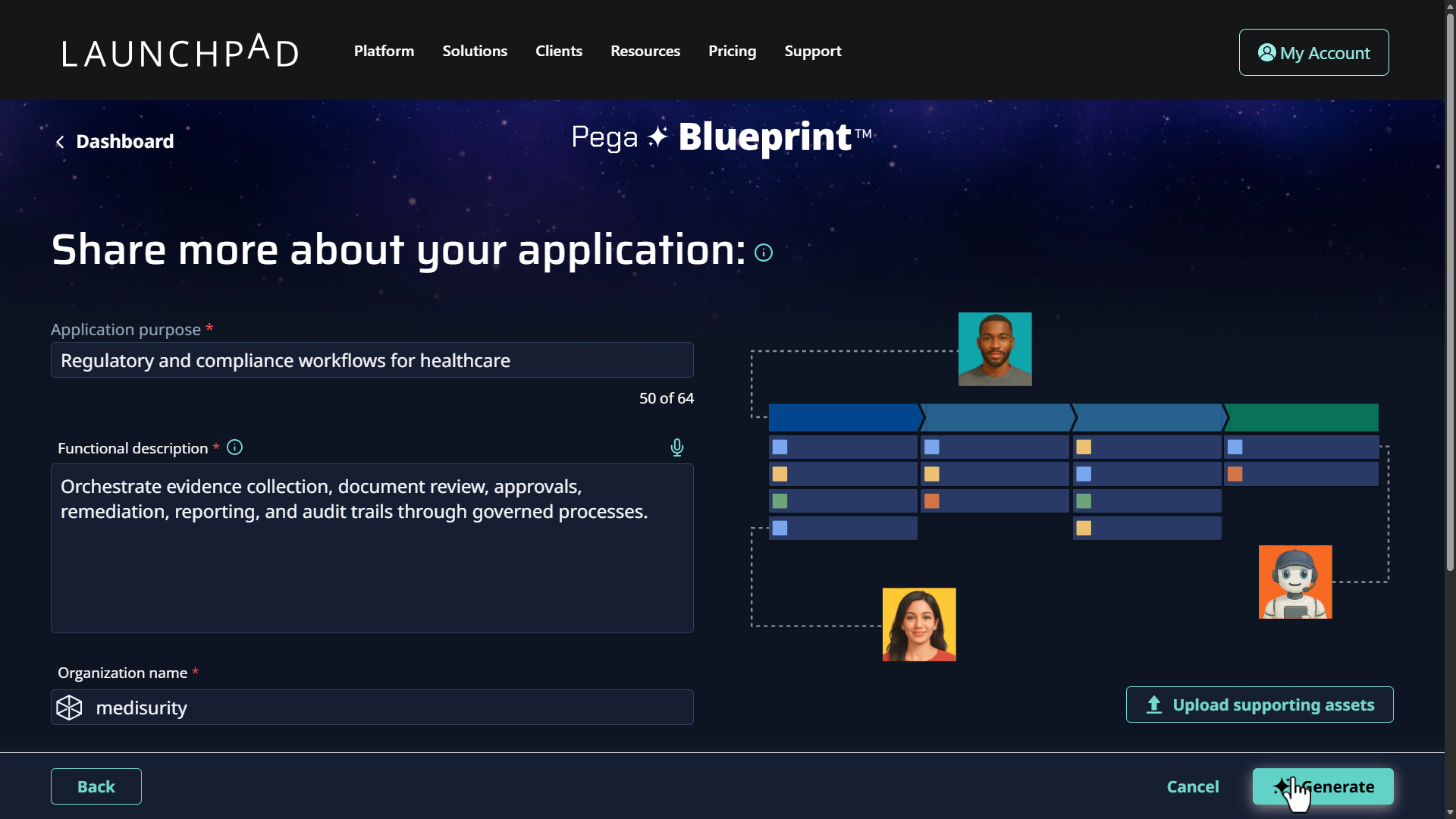
Teams can begin by describing an application, such as a patient-support portal, care-coordination solution, prior-authorization workflow, or clinical-trial operations tool. GenAI Blueprint helps structure the initial application design, including data models, workflows, personas, and sample data. Teams can then refine the logic and connect the application to authorized EHR, payer, laboratory, device, or enterprise data sources.
Launchpad also provides enterprise capabilities such as role-based access, isolated subscriber environments, governance controls, and audit logging. Healthcare and life sciences customers should still validate the complete application, deployment model, integrations, contracts, and operating procedures against the specific regulatory requirements that apply to their use case.
The underlying platform approach has already produced measurable results for software providers. Fielo reduced development timelines by more than 50%, while Quavo achieved 25x platform revenue growth using Pega workflow and case-management capabilities that share Launchpad’s foundation.
About the Author
The Launchpad Team empowers companies to build enterprise-grade, AI-powered software that automates work and delivers measurable outcomes—helping them move from idea to market faster.